

Thoughts on the Economics of Memory
by Mardoqueo Arteaga
TL;DR: How do we know whether advertising really worked? Recent research models advertisements as memory cues and I dive deeper into what that means when thinking about its efficacy. An ad can remind you of a category, reactivate a past experience, or make a brand easier to retrieve when a buying need eventually appears. Importantly, the advertiser may not always capture the benefit. Similar competitors can benefit, too, while other advertising can interfere with what gets remembered at all. Having a deep interest in belief formation, this kind of mental model translates to thinking about advertising’s measurement problem, which I argue can lead to every advertiser correctly measuring its own incremental effect correctly while still misunderstanding the aggregate effect

What is advertising actually doing? I have spent much of the last year and a half working on questions related to advertising effectiveness, despite never having intended to work in advertising in the first place. My training in economics, particularly in expectations formation and empirical methods, initially led me to approach advertising as a familiar measurement problem: expose one group, don’t let the other get exposed, and then ask whether behavior changes. The longer I worked on these types of questions, however, the more interesting problem became the mechanism underneath our estimate. Advertising can inform people about products, persuade them of their quality (or lack there-of), signal something about the firm behind them, or simply increase awareness. But there is another possibility that is both more mundane and, economically, more substantial: advertising can make something easier to remember.
A recent paper by Pedro Bordalo, Giovanni Burro, Nicola Gennaioli, Gad Nacamulli, and Andrei Shleifer develops this idea formally (its title, “Ads as Cues”, is stellar in my opinion). Their model begins by exploiting a simple feature of memory: people are more likely to choose a product when past experiences with it are retrieved, and retrieval depends on a combination of how frequently the product has been experienced, how similar the product is to the cue being presented, and then what other memories are competing for recall. They argue that advertising need not change what something thinks about a product, but rather which product comes to mind. Using NielsenIQ household purchase data and Nielsen advertising data across 20 heavily advertised product categories, the authors find that advertising effects are stronger among habitual consumers and that exposure to one brand’s advertising can increase demand for a similar competing brand.
The Coke and Pepsi example they use makes the mechanism intuitive, so I lay it out here. A Pepsi advertisement can remind a habitual Coke buyer of cola and, through that cue, increase the probability that Coke is recalled and purchased. The paper estimates spillovers from Pepsi advertising onto Coke consumption that are comparable in shape and, for frequent consumers, potential substantial relative to the direct effect of Coke advertising itself. Let’s abstract away from this finding that Pepsi advertising inadvertently sells Coke, and instead let’s focus on that an advertisement can activate a category or consumption memory without controlling which brand ultimately captures the resulting demand.
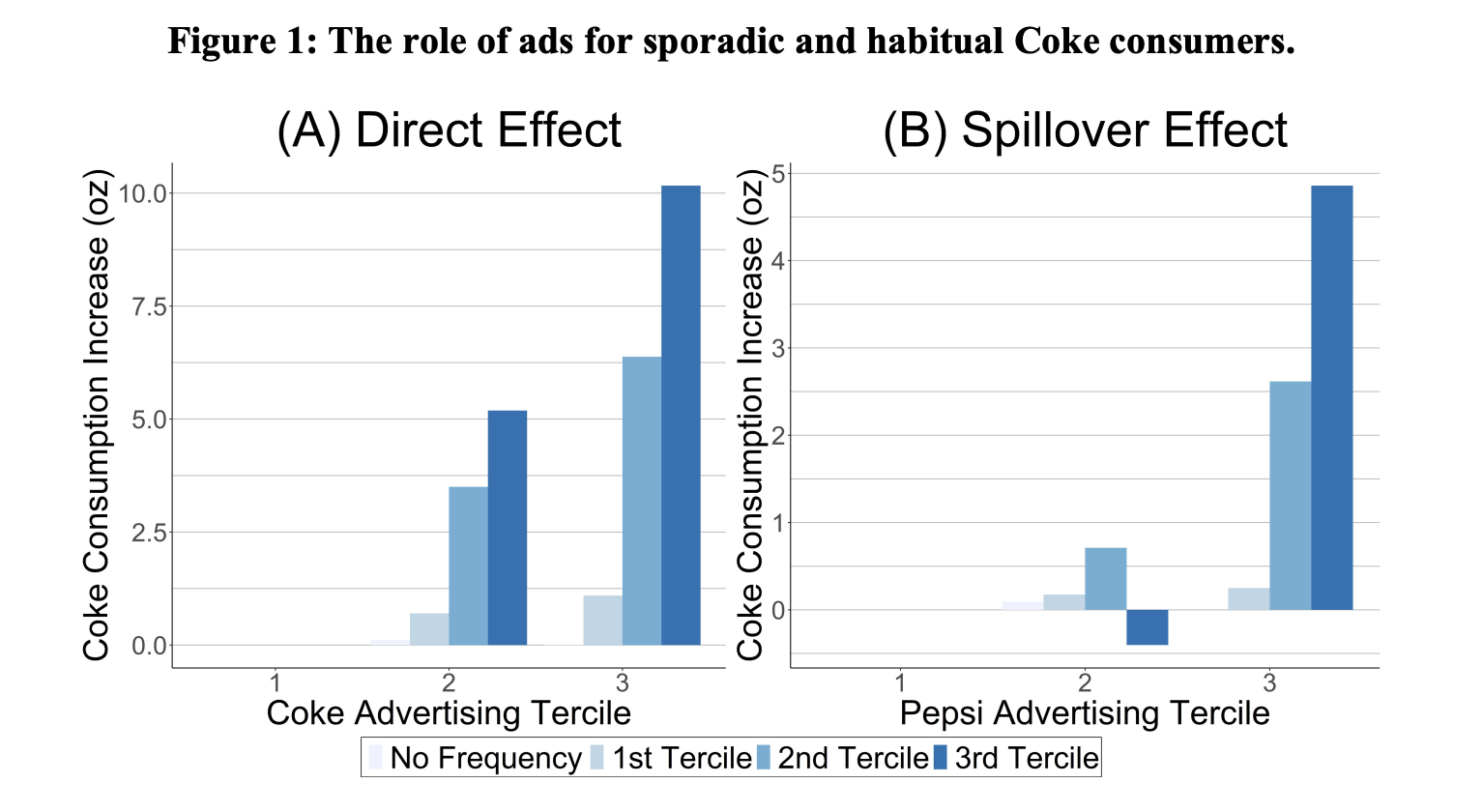
Note: Figure 1 from “Ads as Cues”, with the bars displaying “[weekly change in consumption of Coke in different terciles of Exposure to Coke (left panel) or Pepsi (right panel), compared to in the first Exposure tercile, group by different levels of Coke Frequency.]”. In other words, Panel A is showing that Coke ads cause heavy Coke drinkers (dark blue bars) to drink more Coke, while barely moving the needle for those who rarely drink (light blue). In Panel B, seeing Pepsi ads actually causes heavy Coke drinkers to buy more Coke instead of switching brands. Ergo, the ad is serving primarily as a “cue” to satisfy an existing craving.
Fizzy drink focus aside, this mechanism is found in other categories of products. Navdeep Sahni’s 2016 Journal of Marketing Research paper used randomized field experiments on a restaurant-search platform to study what happened to competitors when one restaurant advertised; advertising increased purchased for both advertised and nonadvertised restaurants, with the spillover concentrated among establishments serving the same cuisine and receiving high customer ratings. The effect was strongest at relatively low advertising intensity and diminished entirely as repeated exposure increasingly favored the advertiser itself. The author interprets this result as consistent with advertising reminding consumers of similar alternatives.
I argue that this distinction is important because several effects that are often grouped together under “brand building” exercises are economically different. For instance, advertising can create demand for a category by informing consumers that a category or use case exists. It can increase the salience of an already familiar category when a reason for purchase arises. It could also build associations between a particular brand and the situations in which a buyer might need it. The Ehrenberg-Bass literature refers to these situations as Category Entry Points: cues that buyers use to retrieve brands from memory when they encounter a need. In B2B markets, where purchases are relatively infrequent and buyers can remain out of market for long periods, those memory structures are particularly important because the advertisement and the eventual buying decision may be separated by months or years. For example, a company may have no reason to think about cybersecurity software today but may have quite the compelling reason to after a breach. It may ignore a consulting firm until an unfamiliar regulatory problem pops up. The immediate response to an advertisement for such services may therefore be negligible, so the economically relevant question is whether the brand becomes retrievable when the underlying need eventually disappears. Recent Linkedin and Bain research on the “Principles of Buyability” makes the practical importance of that familiarity hard to ignore: 81% of purchases in their study were made from vendors that almost everyone in the buying group already knew.
This also provides one way to think about the relationship between brand and performance marketing (aka, demand). Co-authored by yours truly, LinkedIn’s Marketing Science and Technology group recently published modeling showing that integrated brand and demand strategies were associated with 1.4x times as many leads as running the two in isolation. That estimate is modeled rather than experimental, so I would not treat that number as evidence of a causal multiplier per se, but the interesting proposition that it arrives at is that mechanism itself. An upper-funnel exposure may change the state of the buyer on which a later lower-funnel intervention operates. A search advertisement, or a sales message, or a product demonstration, etc., is then reaching someone for whom the brand is already more accessible in memory. In that setting, the contribution of the earlier exposure is neither wholly independent of the later nor necessarily visible in the event immediately following the impressions.
Two further complications coming from this are first that memory affects competition. If similar brands cue one another, an advertiser can create a benefit that it does not wholly capture. And, if we take a consumer’s prior experience into account, the spillover need not be symmetric in its competitive consequence. Imagine that a category cue from a challenger can reactivate a deeply established memory of the incumbent, of which the authors of the paper draw out the example where a market entrant may have an incentive to make its advertising less similar to the established brands in order to avoid generating positive spillovers, particularly to the market leader. I would encourage anyone in this space to treat this as a prediction to investigate because it introduces the unusual possibility that advertising expenditure may strengthen the competitor a firm is trying to displace. Second, memory doesn’t only produce positive spillovers. One of the findings of the paper was that exposure to advertisements in dissimilar categories can reduce demand for a target category. In other words, advertising can make one consumption possibility easier to retrieve partly by marking something else less likely to enter the consumer’s mind. It is in all of these complications that I pose that the economics of memory becomes a measurement problem.
Consider a well-designed experiment for Brand ABCD. Some otherwise comparable markets receive Brand ABCD advertising and others do not, while the competitive environment continues ceteris paribus, business as usual. That experiment can provide a credible estimate of the incremental effect of adding Brand ABCD’s advertising to the market that currently exists. But it is an entirely different question from asking what advertising does tot he category as a whole. Because Brand EFGH’s advertising may increase the salience of ABCD (and vice versa). Advertising from nearby categories may reinforce the underlying need, while sufficiently dissimilar advertising can interfere with retrieval. The measured return to Brand ABCD therefore partly depends on an environment created by expenditures that Brand ABCD does not control. Remove every other advertiser simultaneously and we have changed the environment itself, not just repeated ABCD’s individual counterfactual many times. And this distinction is familiar in economics. A marginal effect estimated while holding the surrounding system fixed will not tell us the effect of changing the entire system, so then summing up incremental effects measured separately for every advertiser would not necessarily recover the effect of advertising on total category demand. I suppose, in short, I would say that I am not arguing that advertising “works even when you cannot measure it”. I’m arguing for being explicit about the estimand. A brand-level experiment can answer whether the intervention changed the outcome relative to a defined counterfactual, but not what would happen if the advertising equilibrium of the market changed.
So why should we care? You don’t have to look around too much to see that advertising measurement has become remarkably sophisticated. We can observe impressions, clicks, website visits, lead submissions, purchases, etc., and yet growth of the observable data does not imply that every economically significant state is being observed. The observable trail may be extensive even though the moment when the brand becomes retrievable from memory remains latent. And this is not just an advertising phenomenon. Markets contain far more information that any individual can continuously evaluate, meaning that choice is partly dictated by what gets noticed, or encoded, and what can be retrieved when a decision has to finally be made. Advertising is just an unusually visible case where firms pay explicitly for the opportunity to influence that process. All in all, a fun thought experiment!
Sources:
Bordalo, Pedro, Giovanni Burro, Nicola Gennaioli, Gad Nacamulli, and Andrei Shleifer. “Ads as Cues.” NBER Working Paper no. 34387, National Bureau of Economic Research, Oct. 2025. doi:10.3386/w34387.
LinkedIn Marketing Science and Technology. “The Multiplier Effect: How LinkedIn Ads Boosts Search, Content, and Pipeline.” LinkedIn for Marketing Blog, June 2026.
Dawes, John. Advertising Effectiveness and the 95-5 Rule: Most B2B Buyers Are Not in the Market Right Now. The B2B Institute, LinkedIn, 2021.
Romaniuk, Jenni. Category Entry Points in a Business-to-Business (B2B) World. Ehrenberg-Bass Institute for Marketing Science and LinkedIn’s B2B Institute, July 2022.
Sahni, Navdeep S. “Advertising Spillovers: Evidence from Online Field Experiments and Implications for Returns on Advertising.” Journal of Marketing Research, vol. 53, no. 4, Aug. 2016, pp. 459–478. doi:10.1509/jmr.14.0274.
Turner, Mimi. “The Principles of Buyability: Why Strong Deals Stall and What Separates the Vendors Who Get Chosen.” LinkedIn for Marketing Blog, 11 June 2026. Research conducted in partnership with Bain & Company.
Voss, Kelsey. How B2B Marketers Can Respond to AI-Accelerated Buying Cycles: AI Reshapes How and When B2B Buyers Evaluate Brands. EMARKETER, 26 Mar. 2026.