

How to Sell to a Customer Who Isn't Human
by Mardoqueo Arteaga
I’ve been in the holiday mood since right after Halloween. If you’re like me, holidays also mean thinking about the possibilities of the future. So, after watching Hocus Pocus and switching to Polar Express, I found myself doom-scrolling through economic forecasts.
The IMF’s latest World Economic Outlook paints a sober picture. Global growth is expected to slow to just 3.1% in 2026, with the outlook described as “dim prospects” amid persistent downside risks. In plain English: the economic pause many of us felt this year isn’t ending anytime soon.
To distract myself, I thought about online shopping and ended up writing this instead. I felt like changing our time together in this piece to think about a more intriguing shift quietly unfolding in the digital plumbing of our economy. The advertising and marketing world is bracing for a 2026 where the traditional search funnel as we know it may fundamentally change thanks to consumers delegating their shopping to AI.

The “Agentic” Economy
For the last two decades, the internet economy followed a familiar, if somewhat funny, dance: a human feels a need, types a few keywords into Google, clicks a blue link (or maybe an ad), browses options, and eventually buys something.
The music is now changing. In 2026 and beyond, we anticipate the rise of AI shopping agents at scale. These are autonomous software agents that can plan, execute, and transact on your behalf. Imagine telling your phone: “Book me a hotel in Miami for the cruise in January, under $300, near the port,” and it just… does it. No scrolling. No ads. No multi-step funnel.
This incoming “agentic economy” where personal AI agents act as trusted representatives for individuals could make traditional marketing funnels obsolete. Tech giants are already heavily investing here. Apple’s on-device intelligence and Google’s projects (like Project Astra) envision a future where a personal AI handles tasks across apps and services. In short, machines are starting to do the shopping, and it poses an existential question for marketers: How do you sell to a customer that isn’t human?
The stakes are enormous. The global digital advertising industry is built on capturing human eyeballs throughout that funnel dance. What happens when they never even look at a webpage or search result? Tech insiders are already sounding alarms. As Bill Gates put it, “Whoever wins the personal agent, that’s the big thing, because you will never go to a search site again, you will never go to Amazon again.” In other words, if AI agents handle our discovery and purchases, the entire traffic model of the web (and all the ads along with it) gets upended.
When Your Customer Is an Algorithm
This is where the economics get fascinating, and perhaps a bit unsettling for advertisers. When a consumer delegates their purchase journey to an AI, the brand no longer needs to persuade a human; it needs to persuade an algorithm.
The traditional playbook of building brand awareness through catchy Super Bowl ads or influencer partnerships won’t move the needle if the AI agent simply doesn’t see those campaigns. An AI personal assistant doesn’t watch TV or scroll Instagram; it cares about things like structured data, product availability, price, and speed. Bain’s industry analysis earlier this year noted, “the marketing funnel is being upended” by AI tools that compress the discovery-to-decision process, reducing opportunities for brands to influence consumers or even appear at all during the journey.
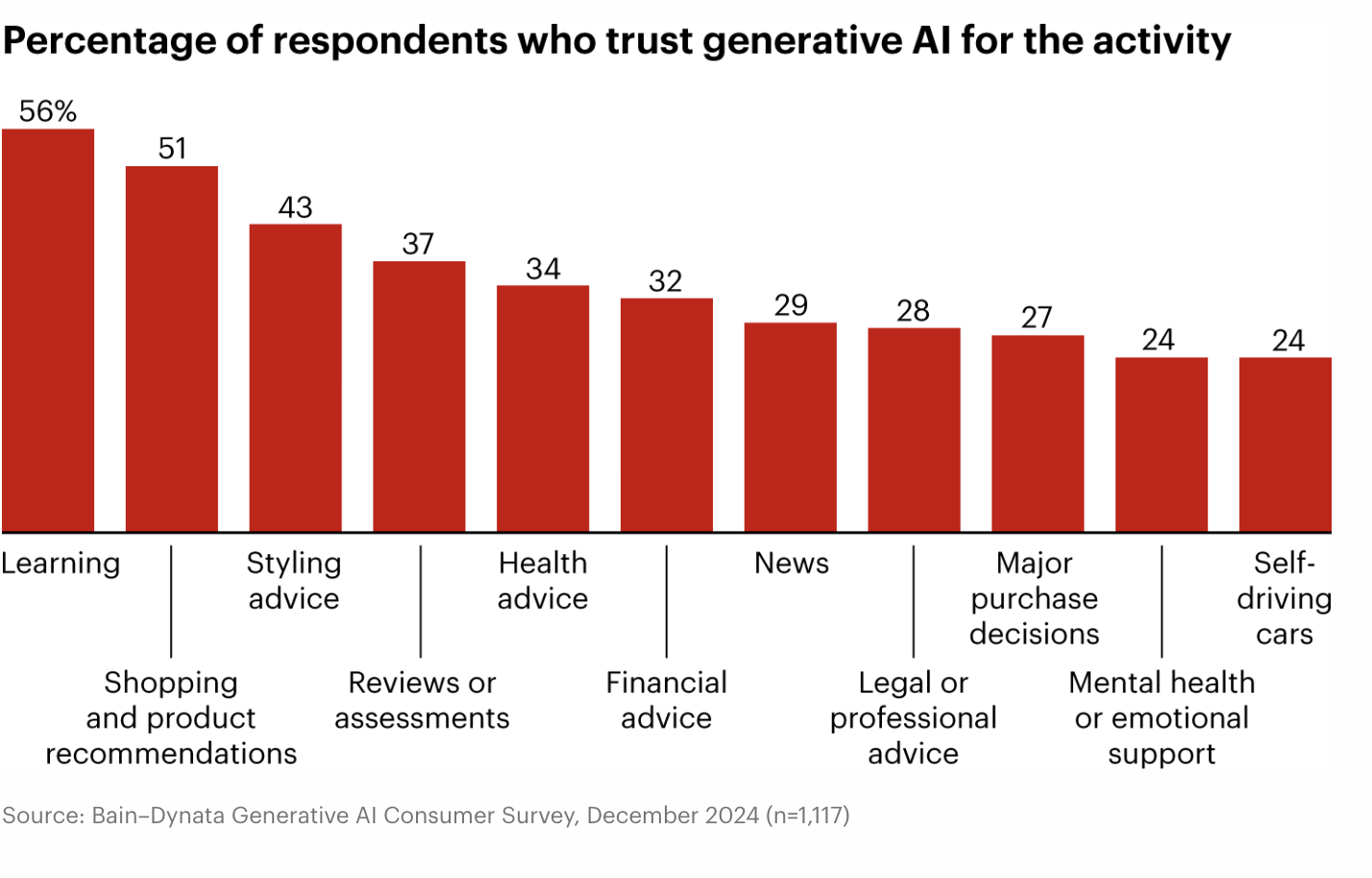
Early evidence of this shift is already here. According to the same article, traffic to many company websites from traditional search had dropped by up to 30% by mid 2025, while referral traffic from generative AI sources is climbing rapidly. Adobe Analytics reported that in early 2025, traffic to retailer sites coming from AI assistants surged 1,200% compared to mid-2024.
These “zero-click” AI journeys mean consumers get their answers or product recommendations without ever clicking through to a website. The search funnel is effectively being cut out of many transactions. In one moment a customer has a vague interest, in the next their AI has given a specific recommendation or made a purchase, all in a single step. The funnel fragments into pieces that move quickly out of sight, increasingly controlled by the AI agent rather than the buyer.
For businesses, this means the new “customer” at the end of the funnel is often a piece of software. In practical terms, your marketing materials and offers might be “seen” first (and only) by an AI intermediary. Corporate leaders are starting to grapple with this reality. Amazon, for example, has voiced concern that a shift to AI shopping agents could reduce traffic to its site and hurt its lucrative ad business. If instead of searching and browsing on Amazon’s app a customer simply commands an AI to order the best product, Amazon loses visibility (and advertising opportunities). It’s no wonder Amazon and others are racing to adapt, either by updating their systems to control how external AI agents access their data or developing their own shopping agents to stay in the loop.
Optimizing for the "ea-customer"
In this new landscape, persuading an algorithm requires a whole new strategy. Some pundits are calling it Agent Engine Optimization (AEO), the successor to the more well known relative, SEO. Instead of optimizing for Google’s PageRank, companies will need to optimize for AI recommendation engines. Gartner’s report last month predicts that by 2028 traditional SEO and paid search will give way to AEO, because products must be machine-readable to be found by AI agents.
Or, supposing I can put it more bluntly, your future customers might not be humans but agents. Think about going from e-customers to ea-customers (electronic agents). It is in that future that building clean, documented APIs is going to be vital. If your future customer can’t ‘read’ and ‘use’ your service, you risk becoming invisible in the virtual shelf.
What does an AI-friendly brand look like? It means having product information structured in a way that AI can easily parse (for you visualizers, think rich metadata and pricing feeds), and even offering interfaces (APIs) for agents to transact directly. It also means meeting algorithmic criteria like being in the top results of an AI’s “consideration set” for certain queries.
Personal AI agents are ruthlessly pragmatic: they will compare specs and prices in milliseconds. Ergo, we are probably looking at something like an ‘ActionRank’ where paths will be prioritized based on cost and reliability. The brands that come out on top will be those that provide the best data and the least friction to these automated shoppers. Ultimately, an AI agent won’t care how shiny your ad campaign is but about whether your product feed is accurate.
Trust: Cold Currency in an AI-Driven Market
At first glance, one might think this AI-driven shopping world favors only the cheapest, most commodity-like options. If the ea-customer is just crunching data, won’t it always pick the lowest price or the highest specs?
There’s some truth to that, I’m sure. Being a “good enough and cheap” option might get an AI’s attention. However, this is where human preference re-enters the picture. Human trust and brand reputation become more important, not less, in the age of AI agents.
Think about it: I will only let an AI agent handle my travel booking or grocery order if I trust the brands it will choose on my behalf. If my digital assistant keeps booking me on a bargain airline with terrible service just to save $5, I’m going to override it, or even ‘fire’ that assistant altogether. Savvy consumers will configure their AI agents with their brand preferences and guardrails. “Always prioritize my preferred brands, unless something is significantly better”; instructions like that might guide tomorrow’s AIs.
In a sense, we may explicitly tell our agents which brands we trust, giving those companies a huge advantage in the algorithmic marketplace.
This suggests that many companies today should consider reallocating resources. Instead of optimizing for clicks, they should be optimizing for trust. Instead of pouring endless budget into top-of-funnel ads hoping to grab attention, brands should consider investing in building genuine customer loyalty and authentic credibility that would convince someone to whitelist them in their AI’s preferences. In a world of infinite AI-generated options, the only things that create lasting value are the brands that humans deliberately favor and instruct their agents to stick with.
Building that kind of trust means doubling down on product quality, customer experience, and transparency, which are essentially brand attributes that a human can measure. Interestingly, even as AI takes over many decision steps, the human is still the ultimate “programmer” of their AI agent’s values. This means companies need to consider how to build trust at the algorithmic level to remain in the consideration set. In practice, that could mean certification programs or data-sharing arrangements that let AI platforms know your brand is trustworthy. It could also mean, according to Bain, leveraging third-party endorsements and reviews, which AIs tend to weight heavily as they try to validate information. (In fact, Bain found that large language models prefer content like expert opinions and customer reviews over pure branded marketing in their results, a signal that authenticity and earned media boost an AI’s trust in a brand.)
Bottom Line
Brand loyalty will likely become algorithmic very soon. The brands that cultivate true loyalty will effectively have customers programming their AI agents to “buy this brand unless there’s a great reason not to.” Everyone else risks being treated as interchangeable by the machines.
Works Cited:
Biltz, P., Hannon, A., Kincaid, C., & Zink, N. (2025, August). Marketing’s New Middleman: AI Agents. Bain & Company. Retrieved from: https://www.bain.com/insights/marketings-new-middleman-ai-agents/
Clifford, C. (2023, May). Bill Gates predicts the ‘big winner’ in AI: Smart assistants will change how you shop, travel and more. CNBC. Retrieved from: https://www.cnbc.com/2023/05/22/bill-gates-predicts-the-big-winner-in-ai-smart-assistants.html
Gartner. (2025, October). Gartner Top Strategic Predictions for 2026 and Beyond. Retrieved from: https://www.gartner.com/en/articles/strategic-predictions-for-2026
International Monetary Fund. (2025, October). World Economic Outlook: Global Economy in Flux, Prospects Remain Dim. Retrieved from: https://www.imf.org/en/publications/weo/issues/2025/10/14/world-economic-outlook-october-2025
Johnson, A. (2025, September). Amazon implements guardrails as AI agents threaten traffic and ad revenues. eMarketer. Retrieved from: https://www.emarketer.com/content/amazon-implements-guardrails-ai-agents-threaten-traffic-ad-revenues
Stroud, M. (2025, January). Agentic AI and Marketing: The Death of the Traditional Funnel? CMSWire. Retrieved from: https://www.cmswire.com/customer-experience/agentic-ai-and-marketing-the-death-of-the-traditional-funnel/