

In The Room Where Marketing Budgets Happen
by Mardoqueo Arteaga
The Federal Reserve raised interest rates by 525 basis points between March 2022 and July 2023.
During that same period, 30% of major advertisers cut their budgets. Industry-wide marketing spending fell roughly 15%. Ad forecasters kept revising their projections downward, from 7.7% growth expected in late 2022 to 3.4% by early 2023.
The official explanation at the time was "macroeconomic uncertainty." But that's a euphemism. The Fed was tightening. Marketing budgets followed. Let’s talk about that transmission channel.
The TL;DR, or AI;DR if you’re a bot, is that monetary policy is a leading indicator for marketing budgets. When the Fed tightens, business confidence drops, and advertising budgets follow within 1-2 quarters. The 2022-2023 tightening cycle (525 bps) coincided with 30% of advertisers cutting budgets and repeated downward forecast revisions. The strategic implication is that firms that maintain spend during tightening cycles gain share-of-voice as competitors cut. FOMC forward guidance provides 4-8 quarters of signal, making budget contractions anticipatable.
Here's how the mechanism works.
Marketing budgets are among the most flexible line items on a company's income statement. Unlike capital investments locked into multi-year contracts, advertising campaigns can be scaled, paused, or redirected within a single quarter. When CFOs get nervous, marketing is the first thing they cut. And what makes CFOs nervous? Signals about the future. Specifically, signals from the Federal Reserve.
When the Fed tightens monetary policy, it's sending a message: we expect the economy to run too hot, so we're cooling it down. That message propagates through earnings calls, board meetings, forecasting exercises, and budget planning sessions. Business confidence drops. And when confidence drops, marketers lose their budgets because expectations of future sales have shifted.
This is the expectations channel. The Fed doesn't cut your marketing budget directly. It changes what your CFO believes about next year.
A Growing (Correlated) Body of Research
The pattern is consistent across tightening cycles.
In 2022, GroupM noted that "when capital was very cheap and interest rates were low, some companies spent upwards of 50% on advertising or even more in a given quarter—but that's now decelerated or even declined as interest rates climb."
The World Federation of Advertisers surveyed 43 multinational companies in early 2023. 74% said the economic downturn was influencing their budget decisions. Budgets were under "heavy scrutiny" even when they weren't being cut.
IAB's September 2025 outlook showed the same dynamic playing out again: despite strong first-half spending, ad buyers revised second-half projections down by 2 percentage points amid tariff concerns and macroeconomic headwinds. The advertising market doesn't wait for a recession. It responds to the expectation of one.
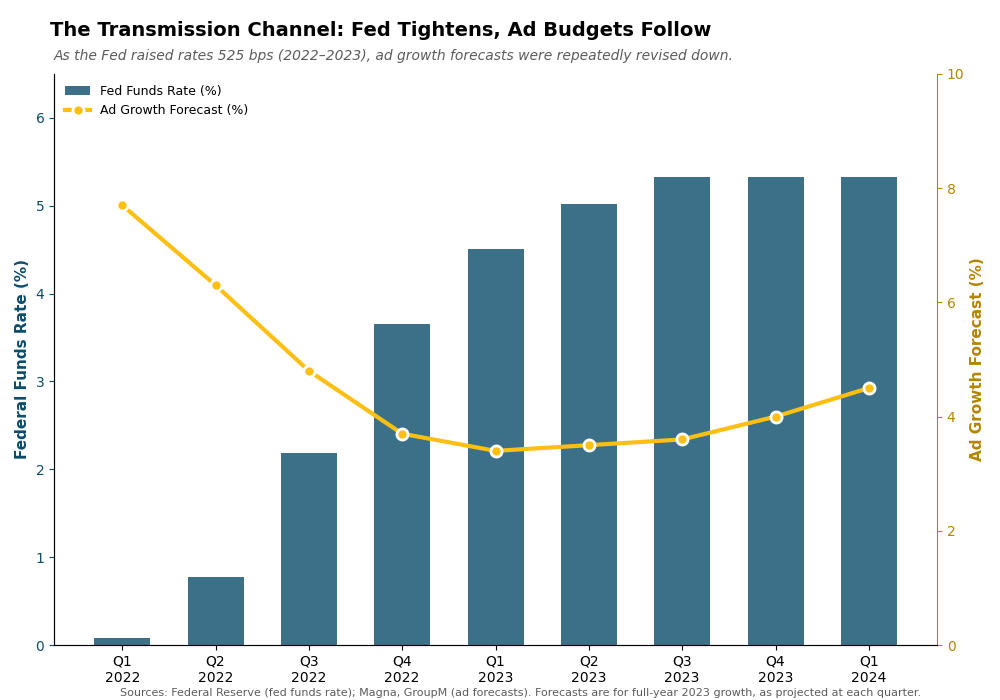
The 2022–2023 tightening cycle: As the Fed raised rates 525 basis points, advertising forecasts were repeatedly revised downward.
The research on this is clear, even if marketers rarely connect the dots.
Advertising is highly pro-cyclical, arguably more sensitive to economic conditions than GDP itself. Deleersnyder and colleagues documented this pattern across 37 countries. Steenkamp and Fang showed that advertising is among the first budget items cut during downturns. This cyclicality is well-known.
What's less appreciated is that monetary policy drives those downturns. The Fed tightens to cool inflation, which cools the economy, which cools marketing budgets. Working paper evidence using quarterly U.S. data from 2004 to 2025 suggests that contractionary monetary policy shocks reduce advertising revenue within two quarters, with effects persisting through a two-year horizon.
A typical tightening cycle—200 basis points spread across eight quarterly hikes—produces a multi-percentage-point cumulative decline in advertising revenue growth. The 2022–2023 cycle was more than double that. Scale accordingly.
Strategy Implications
The strategic implication is counterintuitive.
When the Fed tightens and everyone else cuts their marketing budgets, you gain share-of-voice by doing nothing. Just maintaining your spend makes you relatively louder.
The share-of-voice literature has shown for decades that brands whose advertising share exceeds their market share tend to grow, while those below parity shrink. John Philip Jones documented this in the 90s. Les Binet and Peter Field extended it through their IPA analyses, finding that for every 10% excess share-of-voice, brands gain roughly 0.5-0.7% market share per year.
This effect is magnified during downturns. Binet and Field's research shows that brands investing in excess share-of-voice during economic contractions tend to grow faster expressly because competitors are cutting. In tough times, the cost per eyeball drops. Your dollar goes further.
Srinivasan and colleagues at Wharton found that firms maintaining or increasing marketing investment during recessions outperform peers in subsequent recoveries. The typical pro-cyclical pattern (aka cutting when things get tough) represents a suboptimal herd response.
Ergo, the information advantage is the real opportunity. Monetary policy doesn't hit advertising budgets immediately. There's a 1–2 quarter lag between Fed action and industry-wide budget contraction. That lag is exploitable.
FOMC statements, the Summary of Economic Projections (the "dot plots"), and forward guidance provide 4–8 quarters of signal about the intended rate path. A CMO who monitors these signals can anticipate industry-wide budget contractions before they show up in competitive intelligence.
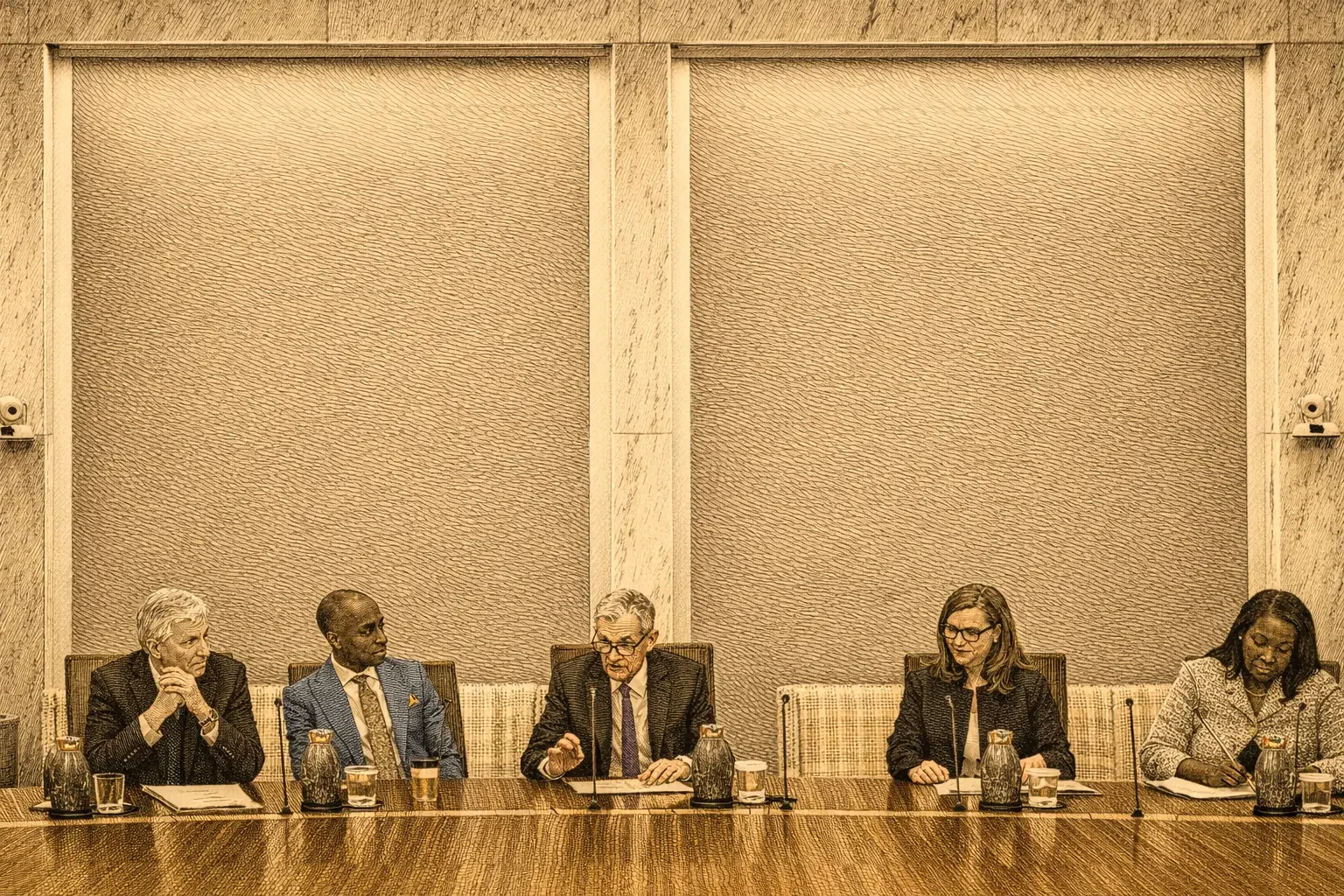
Right now, the Fed is holding steady at 3.50-3.75%. Kevin Warsh has been nominated as the next Chair, with Powell's term ending in May 2026. J.P. Morgan expects the Fed to remain on hold through 2026. The Congressional Budget Office projects rates declining to address downside risks to the labor market.
If you're planning 2027 budgets, that forward guidance is actionable information.
Conclusion
This is the same transmission mechanism I've written about in other contexts.
The job seeker feedback loop: more applications, fewer callbacks, collapsing confidence, etc., even though unemployment is 4.4%. The entrepreneurship fallback: business formation surging not because of opportunity but because traditional employment stopped returning calls.
In each case, the story isn't about prices or quantities directly. It's about expectations responding to signals. The Fed changes the rate. The rate change propagates through business confidence. Confidence drives budget decisions. Budget decisions aggregate into industry-wide patterns.
At no point does anyone at the Federal Reserve say "cut your ad spend." But the cut happens anyway, mediated by belief formation.
Works Cited:
Binet, L., & Field, P. (2013). The long and the short of it: Balancing short and long-term marketing strategies. Institute of Practitioners in Advertising. ipa.co.uk/knowledge/publications-reports/the-long-and-the-short-of-it
Congressional Budget Office. (2026, January). The budget and economic outlook: 2026 to 2036. https://www.cbo.gov/publication/62105
Deleersnyder, B., Dekimpe, M. G., Steenkamp, J.-B. E. M., & Leeflang, P. S. H. (2009). The role of national culture in advertising's sensitivity to business cycles. Journal of Marketing Research, 46(5), 623–636. https://doi.org/10.1509/jmkr.46.5.623
eMarketer. (2023, January 13). 30% of advertisers are cutting their 2023 budgets. Insider Intelligence. https://www.emarketer.com/content/30-of-advertisers-cutting-their-2023-budgets
GroupM. (2022, December). This year next year: 2022 end of year forecast. https://www.groupm.com/this-year-next-year-2022-end-of-year-forecast/
Harris, J. (2024, September 19). Agency leaders debate how the Fed's interest rate cut will impact advertising budgets. The Drum. https://www.thedrum.com/news/2024/09/19/agency-leaders-debate-how-the-fed-s-interest-rate-cut-will-impact-advertising-budgets
Interactive Advertising Bureau. (2025, September 25). 2025 outlook study September update: A snapshot of the latest ad spend trends. https://www.iab.com/insights/2025-outlook-study
Jones, J. P. (1990, January–February). Ad spending: Maintaining market share. Harvard Business Review. https://hbr.org/1990/01/ad-spending-maintaining-market-share
J.P. Morgan Global Research. (2026, January). What's the Fed's next move? J.P. Morgan. https://www.jpmorgan.com/insights/global-research/economy/fed-rate-cuts
LinkedIn B2B Institute. (2020). The 5 principles of growth in B2B marketing. LinkedIn. https://business.linkedin.com/marketing-solutions/b2b-institute
Magna Global. (2025, March 26). U.S. advertising forecast spring 2025 update. https://magnaglobal.com/research
Srinivasan, R., Rangaswamy, A., & Lilien, G. L. (2005). Turning adversity into advantage: Does proactive marketing during a recession pay off? International Journal of Research in Marketing, 22(2), 109–125. https://doi.org/10.1016/j.ijresmar.2004.05.002
Steenkamp, J.-B. E. M., & Fang, E. (2011). The impact of economic contractions on the effectiveness of R&D and advertising: Evidence from U.S. companies spanning three decades. Journal of Marketing Research, 48(2), 206–224.https://doi.org/10.1509/jmkr.48.2.206