

India’s Frontier Bet Faces a Hard Constraint… Ownership
by Kent O. Bhupathi
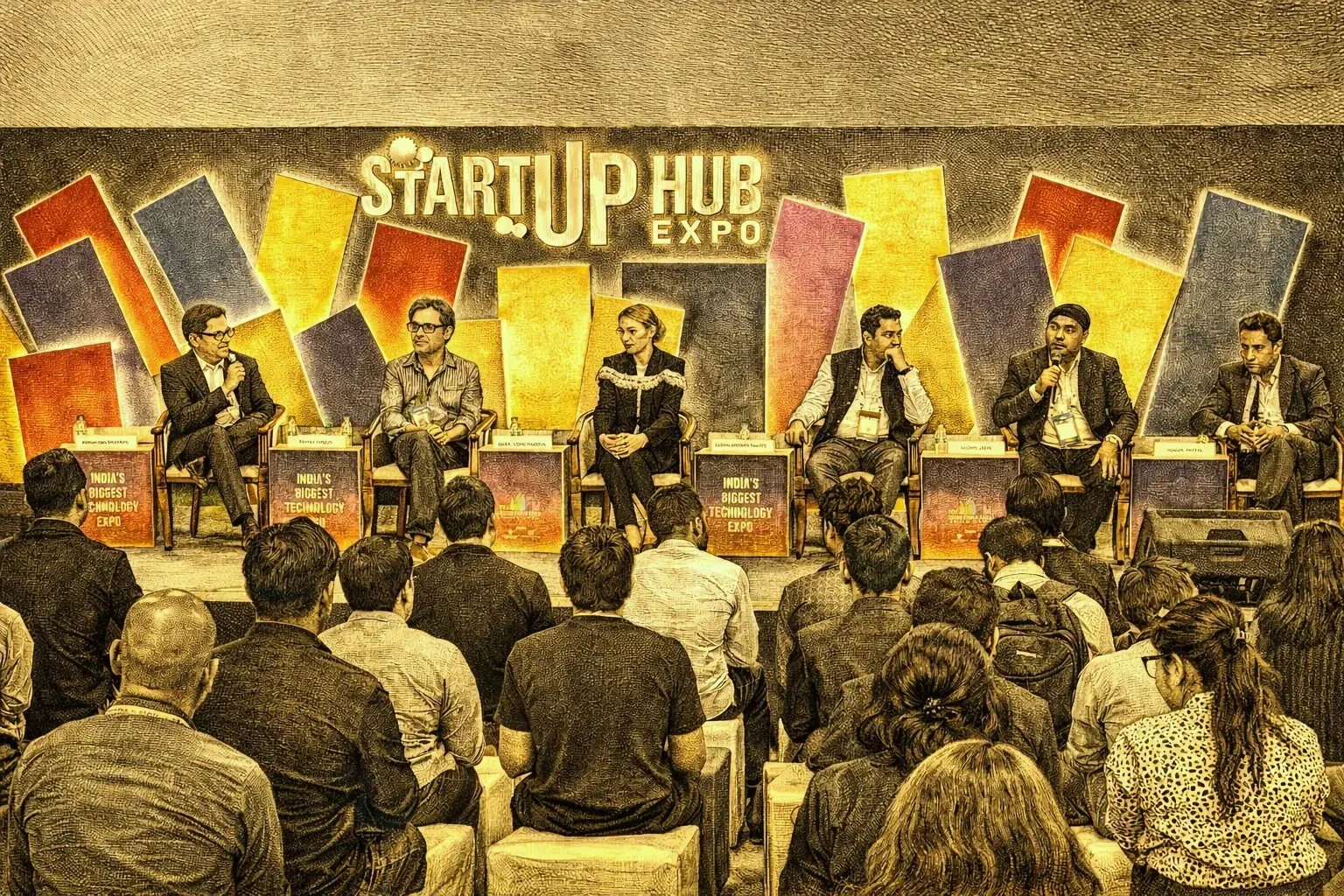
At the 33rd Convergence India Expo in New Delhi this week, I kept hearing the same message in different forms... "build now", "solve real problems now", and "stop waiting for perfect conditions". And the mood certainly matched the slogan.
Overall, the event was exceptionally well organized. The conversations were lively, the technology on display felt commercially serious, and the message across panels was unusually consistent. Whether the topic was 6G, AI or quantum, it was clear that India is not dabbling anymore. It wants indigenous technological progress. It wants to be a serious force in global intellectual property. And it wants to matter not just as a market, but as a maker.
I left energized, but also suspicious of easy optimism…
I wouldn’t say it’s because India lacks ambition. I saw plenty of that. The real issue is whether that ambition can be converted into domestic ownership before global incumbents lock up the most valuable parts of the stack. Not at all impossible… only that it’s a rather tall order.
In real terms, though, it means IP that Indian firms and institutions actually own. So, actual influence over the standards, not just compliance with them. It also means secure access to compute, testbeds, tooling, and critical components. Above all, it means the ability to capture the legal and commercial upside of frontier technologies instead of doing the hard work while someone else collects the royalties.
That is the test now. Participation is not control. Infrastructure is not ownership. And in frontier technology, showing up just does not cut it.
India Has Built a Real Base
To be fair, India has built much more than a slogan. From what I have seen, there is a genuinely stack-shaped public effort here.
Bharat 6G Vision is tied to a stated target of 10% of global 6G patents, supported by the Bharat 6G Alliance, 100 5G labs across academic institutions, and testbeds in THz and advanced optical communications. IndiaAI includes a public compute layer of 10,000+ GPUs, an AI marketplace, an innovation center for indigenous models, datasets infrastructure, and skilling programs that reach beyond the usual elite enclaves. The National Quantum Mission has defined goals across computing, communications, sensing, and metrology, including 50–1000 qubit systems and inter-city or satellite quantum communications. Meanwhile, the National Supercomputing Mission reports 37 systems, 40 petaflops of capacity, and support for 10,000+ researchers. Parliament’s 2025 reply on the Telecom Technology Development Fund also quantified 104 approved projects worth ₹275.88 crore (≈ $30M).
The financing behind this is also substantial. As published, public outlays of ₹10,371.92 crore (≈ $1.1B) for IndiaAI, ₹6,003.65 crore (≈ $640M) for the National Quantum Mission, ₹76,000 crore (≈ $8B) for Semicon India, ₹12,195 crore (≈ 1.3B USD) for telecom PLI, and ₹4,500 crore (≈ $500M) for the National Supercomputing Mission are helping to grow this market. That is not the profile of a country treating frontier technology as an afterthought.
So yes, India has built a foundation. The more uncomfortable question is what that foundation is actually buying.
The Problem Is Not Activity, but Capture
A sovereign technology stack does not mean autarky. It means credible influence or control over the layers that matter most, whether in standards and IP rents, compute and software capability, manufacturing and supply-chain resilience, or the security architecture around deployment. That is the only serious way to define it.
That framing matters because a country can be extremely active in frontier technology and still lose the value-capture game.
AI offers the clearest example. India’s talent base is undeniably strong. Stanford’s AI Index puts India’s AI skill penetration score at 2.8 over 2015-2023, ahead of the U.S. at 2.2 and Germany at 1.9. But talent alone does not secure ownership. In 2022, India accounted for just 0.23% of the world’s granted AI patents, compared with 61.13% for China and 20.90% for the U.S. That is the difference between participating at the frontier and owning part of it.
The capital picture tells a similar story. India’s public posture is meaningful, but private frontier capital still lags badly. In 2023, private AI investment stood at roughly $1.39 billion in India, versus $67.22 billion in the U.S. and $7.76 billion in China. Public missions matter. But without serious private follow-through, they can leave a country with infrastructure and headlines rather than durable corporate capability.
Quantum is even more revealing. OECD-EPO mapping for 2005 to 2024 shows 275 patent families involving Indian inventors and U.S. applicants, compared with just 8 going the other way. India is clearly supplying frontier talent, yet the legal ownership of that work still tends to settle elsewhere. The harder question is why India continues to generate so much of the capability without capturing more of the underlying rights.
6G Will Be a Standards Fight
Telecom makes the ownership problem even more obvious… since that space is ruthless when it comes to “who gets paid”.
India’s official ambition is to capture 10% of global 6G patents. Fair enough. But the more useful warning comes from the 5G standards-essential patent landscape. LexisNexis IPlytics reports more than 85,000 5G patent families declared to ETSI before October 31, 2024, along with more than 57,000 active granted 5G patent families in 2024, up from just over 25,000 in 2021. The leading owners are the usual global giants, including Huawei, Qualcomm, and Ericsson. By the time standards power hardens, it is already concentrated, cumulative, and extremely profitable for those inside the castle walls.
But India does have real reasons for confidence here. The Telecommunications Act, 2023 gives clearer powers around standards and includes a regulatory sandbox. TRAI has recommended THz experimental authorization from 95 GHz to 3 THz. India also has a real precedent in 5Gi’s integration path into 3GPP. In plain English, India has shown it can influence global specs when it shows up with technical substance and persistence.
But that last word, persistence, matters. A 10% target sounds impressive, but official talk of "6G IPR" is still frustratingly vague. Does it mean patent filings, granted patents, global patent families, or truly standards-essential patents? Those are not minor distinctions. They mark the difference between a target that earns applause and one that delivers licensing power.
India’s Tailwinds Are Real, but So Are the Headwinds
This is not a pessimistic argument. India has real tailwinds.
WIPO data show 90,298 patent applications at India’s IP office in 2023, with the resident share rising from 24.8% in 2013 to 55.2% in 2023. That is a meaningful structural shift, pointing to a growing domestic filing base even if it still falls short of proving frontier dominance. There are also signs that India can scale a layer of the stack at the national level, with UPI offering the clearest analogy, while 5Gi’s path into 3GPP suggests that standards influence is possible when institutions and engineering capacity move in step.
Still, the headwinds are just as real. Compliance is complex. Export-control exposure remains significant. India is still dependent on globally constrained semiconductor toolchains, and certification or trusted-source regimes can easily slow iteration when they become too opaque or too cumbersome. There are governance gaps as well, especially the limited public visibility into compute allocation, tier-2 and tier-3 access, utilization rates and whether public infrastructure is actually being translated into patents, startups and deployable products.
That is the part people tend to glide past. India can generate ideas. The harder task is converting them into ownership.
What India Needs Is a More Strategic Fiscal State
This is also where the policy debate needs to get less lazy.
India does not mainly need looser fiscal policy. It needs a more strategic fiscal policy.
The broader evidence points in the same direction. Frontier-tech spending needs protection within a credible consolidation path, not annual stop-start improvisation. India cannot credibly claim it is building sovereign capability in AI, quantum, and 6G-adjacent systems if those priorities are treated as discretionary line items that rise and fall with budget mood swings. That is why the case for a protected multi-year strategic-technology envelope is so strong, especially when annual allocations can still look uneven.
The same logic extends to infrastructure. Compute, labs, testbeds, and shared technical platforms should be treated as forms of public capital formation. IndiaAI already provides a useful institutional base, but the goal cannot be limited to subsidizing isolated firms. It should be to overbuild shared national capability that researchers, startups and manufacturers can use to generate domestic IP rather than settle for downstream adoption.
Then there is finance. The ₹1 lakh crore, or roughly $10.6 billion, RDI Scheme could prove to be one of the most important tools in the mix because frontier R&D is structurally short on patient capital. Long-tenor financing, low or zero interest support, equity backing, fund-of-funds participation, and coverage of up to 50% of project costs are exactly the kinds of instruments India needs in AI compute, quantum hardware, photonics, advanced telecom components, and specialized chips. The real issue now is execution and prioritization, not theory.
Tax and procurement matter more than they usually get credit for. Cutting input costs for GPUs, wafers, EDA tools, sensors, networking gear, and cleanroom equipment would do far more than waving around broad protectionism and hoping for a miracle. Procurement, meanwhile, should function as a first-customer scaling tool across defense, railways, energy, health, and telecom rather than as another localization slogan. Talent policy needs real funding behind it too, through return fellowships, secondments, practitioner pathways, and mission-linked labs that keep Indian talent from becoming raw material for someone else’s IP system.
What Execution Should Look Like Now
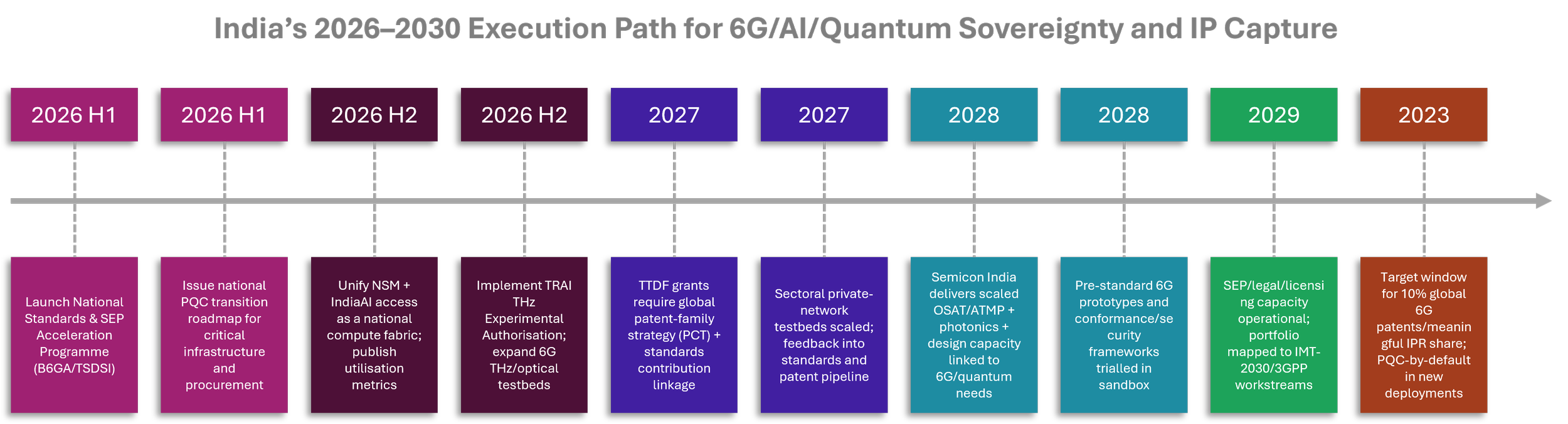
Ultimately, India should establish a National Standards and SEP Acceleration Programme through B6GA and TSDSI. TTDF-funded outputs should be pushed toward global patent families rather than left at the level of domestic filings. NSM and IndiaAI should operate as a single national compute fabric with transparent allocation and utilization metrics. Procurement preferences should be used to create reference buyers for indigenous AI, telecom, and quantum systems. Private-network deployments and industrial testbeds should be expanded so India can generate standards-relevant performance data in real operating environments. Semicon India, meanwhile, should focus on nearer-term wins such as OSAT (Outsourced Semiconductor Assembly and Test), ATMP (Assembly, Test, Mark, and Pack), silicon photonics, and design capacity that directly support 6G and quantum hardware.
None of that is glamorous. But that is exactly why it matters.
To Sum-up
What I saw at Convergence India was real. The energy was unmistakable. So was the seriousness. And the ambition did not feel staged.
But, ambition is the easiest part…
India has built enough infrastructure, institutional scaffolding, and political intent to matter in 6G, AI compute, and quantum. It’s now about whether India can move fast enough, coordinate well enough, and finance intelligently enough to turn that momentum into domestic ownership.
Because that is the actual line separating a major market from a major power.
India can build the stack. The harder part is owning it. And that, frankly, is the only part that really counts.
Sources:
3rd Generation Partnership Project. “Merging 5Gi and 3GPP Specifications.” December 17, 2021. https://www.3gpp.org/news-events/3gpp-news/3gpp-5gi.
Digital India. “National Supercomputing Mission Powers India’s Research Ecosystem with 37 Systems, 40 Petaflops Capacity, Supporting Over 10,000 Researchers Across Diverse Fields.” https://www.digitalindia.gov.in/press_release/national-supercomputing-mission-powers-indias-research-ecosystem-with-37-systems-40-petaflops-capacity-supporting-over-10000-researchers-across-diverse-fields/.
Douarche, Nicolas, Muzio Grilli, Christian Soltmann, Соѕtіnеl Тоtіr, and Markus Volkmer. Quantum Computing: Insight Report. January 2023. https://link.epo.org/web/epo_patent_insight_report-quantum_computing_en.pdf.
European Telecommunications Standards Institute. ETSI Intellectual Property Rights Policy. https://www.etsi.org/images/files/IPR/etsi-ipr-policy.pdf.
Global mobile Suppliers Association. Private Mobile Networks: 4Q23 Report Highlights. 2024. https://www.mfa-tech.org/wp-content/uploads/GSA-Private_mobile_networks_abstract_4Q23.pdf.
Government of India, Ministry of Commerce and Industry, Department of Industrial Policy and Promotion. Public Procurement (Preference to Make in India), Order 2017. June 15, 2017. https://eprocure.gov.in/cppp/sites/default/files/dipp/DIPP_order_dated_15-6-2017_wrt_pppMiI.pdf.
Government of India, Ministry of Commerce and Industry, Department of Commerce. Foreign Trade Policy 2023: Chapter 10—SCOMET: Special Chemicals, Organisms, Materials, Equipment and Technologies. 2023. https://content.dgft.gov.in/Website/FTP2023_Chapter10.pdf.
Government of India, Ministry of Commerce and Industry, Department for Promotion of Industry and Internal Trade. Public Procurement (Preference to Make in India), Order 2017—Revision; regarding. July 19, 2024. https://www.dpiit.gov.in/static/uploads/2025/07/0ee62cb7cfc6586c69e0acd4febb3f2f.pdf
Government of India, Ministry of Communications, Department of Telecommunications. Roadmap for Rollout of 6G Technology in the Country. Rajya Sabha Unstarred Question No. 3215, answered August 21, 2025. https://sansad.in/getFile/annex/268/AU3215_NFqn9d.pdf?source=pqars.
Government of India. The Telecommunications Act, 2023. 2023. https://www.indiacode.nic.in/bitstream/123456789/20101/1/A2023-44.pdf.
GSM Association. Private 5G Industrial Networks: An Analysis of Use Cases and Deployment. June 2023. https://www.gsma.com/solutions-and-impact/technologies/internet-of-things/wp-content/uploads/2023/06/GSMA-Private-5G-Industrial-Networks-Report-June-2023.pdf.
IndiaAI. “Union Minister of Electronics & IT, Railways, and I&B Announces the Availability of 18,000+ Affordable AI Compute Units.” January 31, 2025. https://indiaai.gov.in/article/union-minister-of-electronics-it-railways-and-i-b-announces-the-availability-of-18-000-affordable-ai-compute-units.
International Telecommunication Union. 5G Development in China. https://www.itu.int/en/ITU-D/Regional-Presence/AsiaPacific/SiteAssets/Pages/Events/2024/5G%20Engagement%20and%20Experience%20Webinar%20Series/5G-Engagement-and-Experience-Webinar-Series/5G%20Development%20In%20China.pdf.
Moody, Dustin, Ray Perlner, Andrew Regenscheid, Angela Robinson, and David Cooper. Transition to Post-Quantum Cryptography Standards. NIST Internal Report 8547 (Initial Public Draft). November 2024. https://nvlpubs.nist.gov/nistpubs/ir/2024/NIST.IR.8547.ipd.pdf.
National Institute of Standards and Technology. Federal Information Processing Standards Publication 203: Module-Lattice-Based Key-Encapsulation Mechanism Standard. Gaithersburg, MD: U.S. Department of Commerce, August 13, 2024. https://nvlpubs.nist.gov/nistpubs/FIPS/NIST.FIPS.203.pdf.
Organisation for Economic Co-operation and Development. Mapping the Global Quantum Ecosystem. December 2025. https://www.oecd.org/content/dam/oecd/en/publications/reports/2025/12/mapping-the-global-quantum-ecosystem_47891dd2/20251217-0001.pdf.
Pohlmann, Tim, Marco Richter, and Magnus Buggenhagen. Who Is Leading the 5G Patent Race? 2025 Report. LexisNexis, 2025. https://www.lexisnexisip.com/wp-content/uploads/2025/01/2025-LexisNexis-5G-SEP-Report.pdf.
Press Information Bureau, Government of India. “Rolling Out of 5G Network.” December 14, 2022. https://www.pib.gov.in/PressReleseDetailm.aspx?PRID=1883481®=3&lang=2.
Press Information Bureau, Government of India. “PLI Scheme in Telecom and Networking Products.” December 21, 2022. https://www.pib.gov.in/PressReleasePage.aspx?PRID=1885361®=3&lang=2.
Press Information Bureau, Government of India. “TRAI Releases Recommendations on Tera Hertz Spectrum.” August 21, 2024. https://www.pib.gov.in/PressReleaseIframePage.aspx?PRID=2047397®=3&lang=2.
Press Information Bureau, Government of India. “India’s 6G Vision.” April 3, 2025. https://www.pib.gov.in/PressReleasePage.aspx?PRID=2118200®=3&lang=2.
Press Information Bureau, Government of India. “Building a Viksit Bharat with 6G.” October 26, 2025. https://static.pib.gov.in/WriteReadData/specificdocs/documents/2025/oct/doc20251026676701.pdf.
Prime Minister’s Office, Government of India. “Cabinet Approves National Quantum Mission to Scale-Up Scientific & Industrial R&D for Quantum Technologies.” April 19, 2023. https://www.pmindia.gov.in/en/news_updates/cabinet-approves-national-quantum-mission-to-scale-up-scientific-industrial-rd-for-quantum-technologies/.
Prime Minister’s Office, Government of India. “Cabinet Approves Ambitious IndiaAI Mission to Strengthen the AI Innovation Ecosystem.” March 7, 2024. https://www.pmindia.gov.in/en/news_updates/cabinet-approves-ambitious-indiaai-mission-to-strengthen-the-ai-innovation-ecosystem/.
Stanford Institute for Human-Centered Artificial Intelligence. Artificial Intelligence Index Report 2024. Stanford, CA: Stanford University, 2024. https://hai-production.s3.amazonaws.com/files/hai_ai-index-report-2024_chapter1.pdf.
U.S. Department of Commerce, Bureau of Industry and Security. “Commerce Strengthens Restrictions on Advanced Computing Semiconductors, Semiconductor Manufacturing Equipment, and Supercomputing Items to Countries of Concern.” October 17, 2023. https://www.bis.gov/press-release/commerce-strengthens-restrictions-advanced-computing-semiconductors-semiconductor-manufacturing-equipment.
World Intellectual Property Organization. World Intellectual Property Indicators 2024. Geneva: World Intellectual Property Organization, 2024. https://www.wipo.int/edocs/pubdocs/en/wipo-pub-941-2024-en-world-intellectual-property-indicators-2024.pdf.