

The Melt-Up Is an Information Problem
by Mardoqueo Arteaga
AI;DR: A melt-up, defined as the sharp and sentiment-driven surge as buyers rush in to avoid missing a rally, is usually described in the language of psychology: greed, euphoria, fear of missing out (FOMO). In this article, I try to understand it as an information problem. High participation, heavy volume, and low volatility are not signs of a market processing information well, but rather one that has stopped processing new information at all. If I were to diagnose, stability is the tell-tale symptom and what breaks it is the arrival of information loud enough to make investors trust their own judgment again. Which, in July 2026, is exactly what happened.
Statements that Stop Explaining
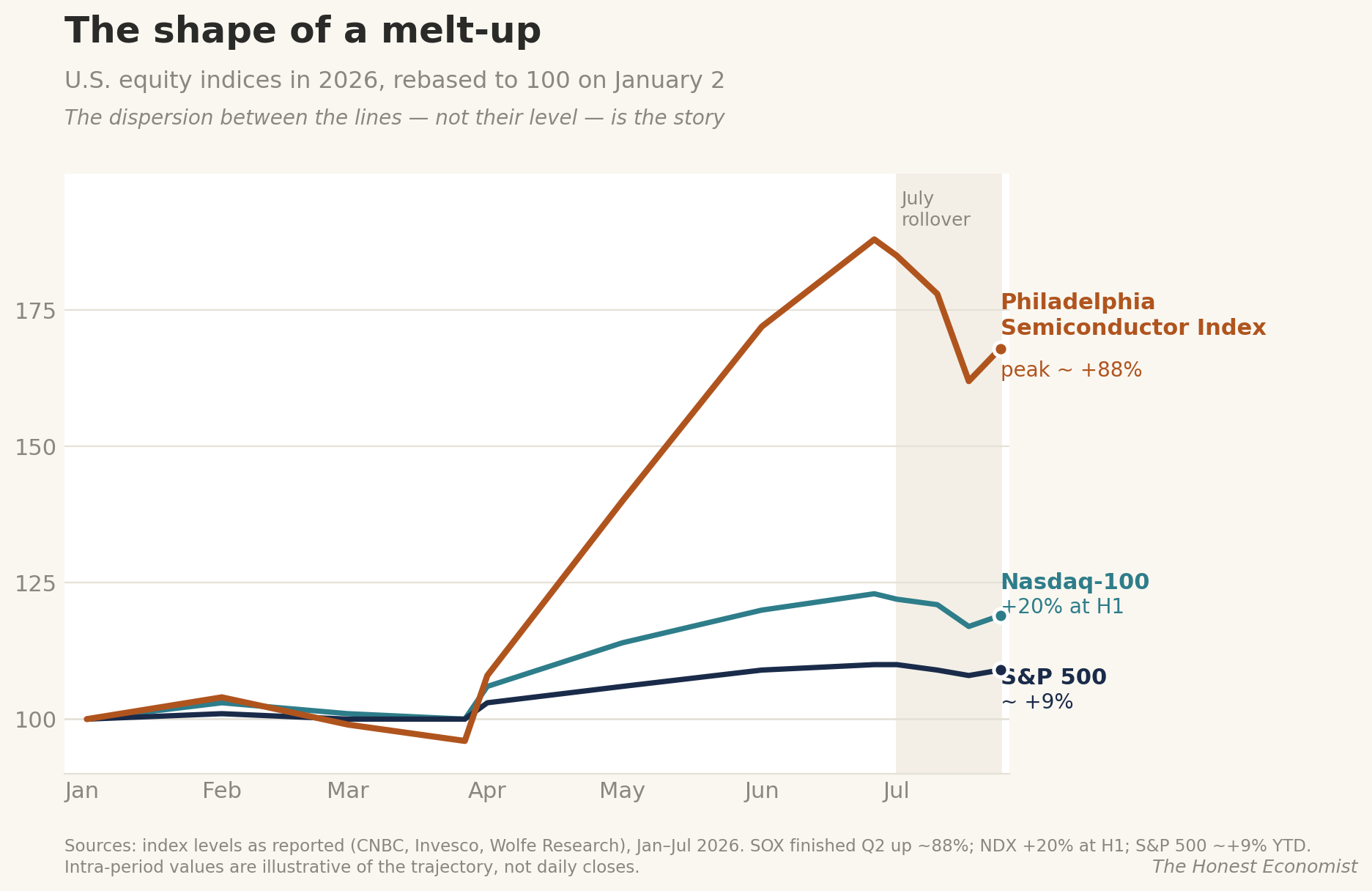
For most of this year, the U.S. equity market has been in the grip of a melt-up. The S&P 500 has climbed roughly 9 percent and set repeated record highs. Meanwhile, the Nasdaq-100 rose 20 percent in the first half, its strongest start since 2023. And semiconductors, the picks-and-shovels of the AI build-out, went vertical: the Philadelphia Semiconductor Index finished the second quarter up roughly 88 percent, moving 95 percent from its spring low to its summer high. One veteran strategist remarked that in a full career he had rarely seen a quarterly move like it.
A melt-up, by the way, is the mirror image of a meltdown. In a meltdown, prices fall sharply as sellers rush for the exit; in a melt-up, they rise sharply as buyers rush for the entrance. Both are driven by the same underlying force wherein participants act on the behavior of other participants rather than on their own assessment of value, and both share an unsettling quality: a melt-up looks a great deal like a panic, one to buy.
The conventional explanation that I read about often reaches for emotion: euphoria, animal spirits, the fear of being left behind (and perhaps the subsequent one of FAFO). But I think that underneath the psychology is a mechanism from information economics that explains both why melt-ups feel so stable while they last and why they end so abruptly.
Cascades and the Suppression of Private Information
In the standard model of an information cascade, developed by Bikhchandani, Hirshleifer, and Welch, individuals make decisions in sequence, each observing the choices of those who acted before them. Each participant holds (or you could say, believes) two things: a private signal about value, and the public information contained in others' behavior. When enough people have acted in the same direction, the rational move for the next participant is to disregard their own private signal and follow the crowd. The weight of observed behavior simply exceeds the weight of any single private assessment.
The critical feature of a cascade is that, once it forms, private information stops entering the system. Each new participant is inferring value from the actions of others, who were themselves inferring value from the actions of others. Price continues to rise, and volume continues to build, but the rise is no longer transmitting fresh information about fundamentals. It is transmitting the accumulated weight of everyone's decision to stop transmitting.
This is why the surface signatures of a melt-up are so distinctive, and potentially so misleading. High participation is going to like broad conviction and fool you more. Heavy volume looks like a market working hard. Low volatility looks like stability and consensus. In fact, all three are what you would expect from a market in which private signals have been switched off. Volatility is low precisely because disagreement has been suppressed and disagreement is how new information enters a price. A market at its calmest can be a market at its most informationally fragile.
Why a Melt-Up Is Not Simply a Bubble
I get it: it is tempting to treat melt-ups and bubbles as synonyms. I mean, they both sound like things related to a hot summer’s day. But they are not and I’d like to focus on that distinction.
A bubble is a sustained detachment of price from any plausible fundamental value. A melt-up is a rate-of-change phenomenon: price rising faster than fundamentals, driven by the cascade dynamics that we discussed. The two are definitely related since, when a melt-up runs long enough, with no fundamental catching up to it, it will inflate into a bubble and eventually collapse. But a melt-up is not doomed to that fate. If earnings and revenue rise quickly enough to meet the price, the gap can close without a crash.
This is where 2026 differs in an important way from the cautionary tales. The run-up has not been entirely untethered from fundamentals. Forward earnings estimates for the Nasdaq-100 rose from 29 percent expected twelve-month growth in December 2025 to 45 percent by the end of June 2026. Succinctly, expectations were climbing alongside price. That does not necessarily prove the market is correctly valued (for sure, expectations can themselves be swept up in a cascade) but it does mean the situation is not the pure fundamental-free mania of a classic bubble. There appears to be a real economic build-out underneath the enthusiasm, which is a consoling sign.
The cleanest evidence that cascades detach from fundamentals comes from the market's fringes, where a company with no credible basis for a repricing can rise several hundred percent in a single session on a thematic announcement. Those episodes are cascades in pure form: price movement carrying no information about value, only about the behavior of the last buyer. Here, we have the tell-tale signs that private signals have stopped mattering, even if not everywhere, but somewhere, and potentially spreading. No bueno.
What Ends a Cascade
A cascade is stable but fragile (an apt description for more than just one thing, I think). Stable because, as long as everyone is following everyone, the equilibrium will sustain itself. Fragile because it rests on no informational foundation so it can be disrupted by something loud coming in from the outside that makes participants trust their private information again. This is what began in July 2026. Many earnings arrived and with them, information the cascade could not absorb, and here are some tales. A major technology company warned of soft demand and its stock fell 25 percent in a session. A leading chipmaker beat expectations but raised its capital-spending forecast so sharply that investors read it as a warning rather than a triumph, and the stock sold off anyway. The semiconductor complex dropped several percent in single sessions; the Nasdaq posted its worst week in months. Investors began, for the first time in the cycle, to weigh whether the price was justified by the fundamentals. Once that processing restarts, the equilibrium that depended on its absence comes apart.
While the ascent of a melt-up requires continuous coordination, the reversal requires only that enough participants simultaneously remember they have private information worth acting on. Like in anything else, coordination is slow to build and quick to break.
A Missing Signal
My dear hungry readers might be thinking that price is supposed to be an information aggregator. In a well-functioning market, it pulls together the dispersed private signals of thousands of participants into a single number. A melt-up is when price starts aggregating imitation instead. We’ve already covered that this phenomenon masquerades as a market that looks calm and confident, supposedly signs of health.
None of this settles whether the AI build-out justifies current prices. The forward earnings estimates suggest there is real substance underneath, and a melt-up backed by genuinely rising fundamentals need not end in a crash. But it does reframe what to watch. So maybe the number that matters is not the level of the index or the intensity of the enthusiasm, but rather whether new information is still moving prices.
Sources:
Bikhchandani, Sushil, David Hirshleifer, and Ivo Welch. "A Theory of Fads, Fashion, Custom, and Cultural Change as Informational Cascades." Journal of Political Economy, 1992. [https://snap.stanford.edu/class/cs224w-readings/bikhchandani92fads.pdf]
Invesco. "Nasdaq-100 Index Commentary." Monthly update, June 30, 2026. [Forward EPS growth estimates.] [https://www.invesco.com/apac/en/institutional/insights/etf/nasdaq-100-Index-commentary-monthly-update.html]
CNBC Markets. Daily market coverage, July 2026. [Index levels, semiconductor moves, earnings reactions.]
Wolfe Research, as reported. Q2 2026 semiconductor index commentary. [https://finance.yahoo.com/markets/stocks/articles/wolfe-research-stays-bullish-equities-104435791.html]