

Column
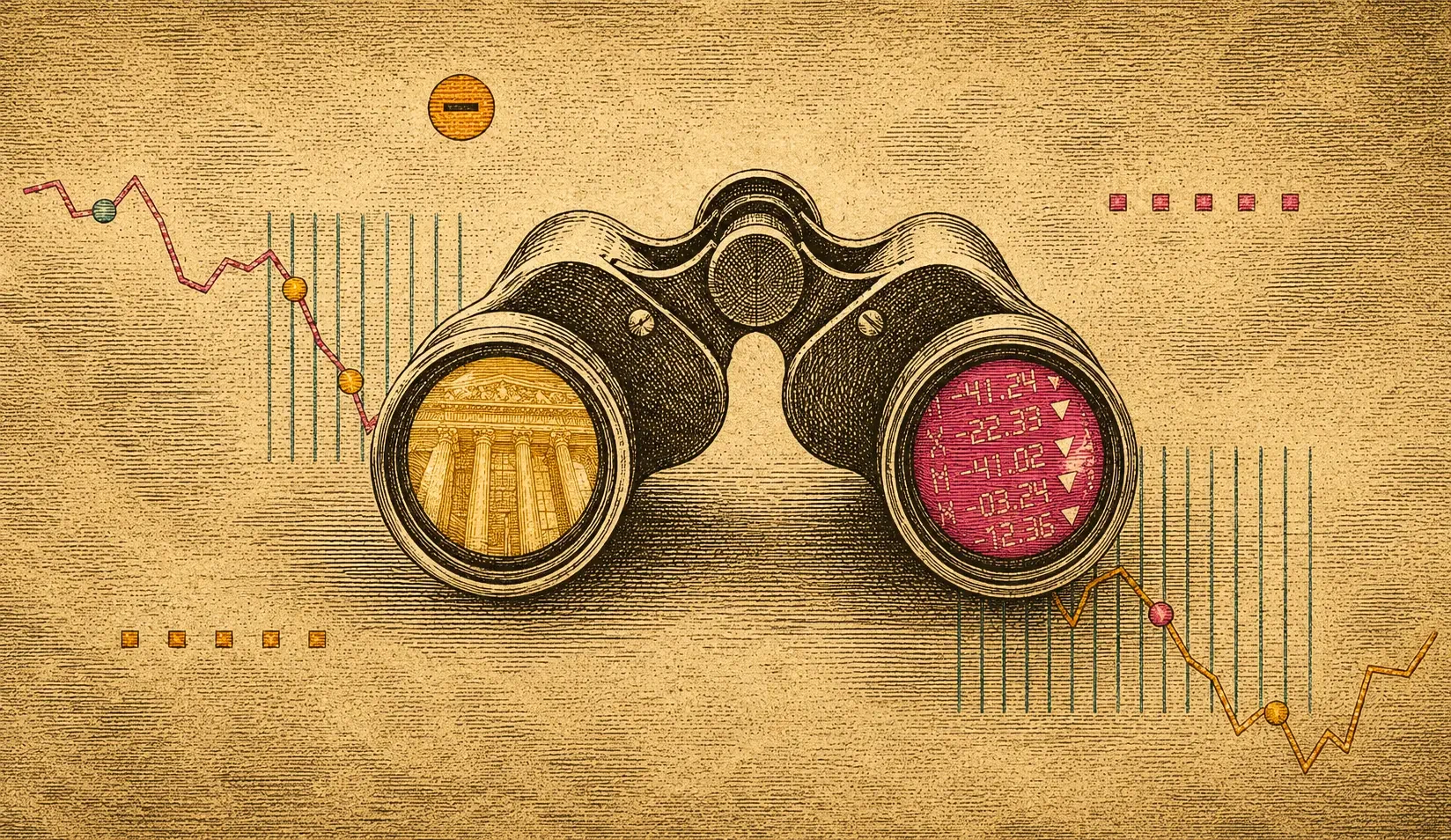
The Melt-Up Is an Information Problem
The article argues that the 2026 AI-led equity melt-up is best understood as an information cascade, not simple euphoria. In a cascade, investors observe others buying and rationally discount their own private signals, so price gains, heavy volume and low volatility can look like conviction while actually reflecting suppressed disagreement. That makes the market appear stable precisely when it may be informationally fragile.
It distinguishes melt-ups from bubbles: a melt-up is rapid price appreciation that can become a bubble if fundamentals fail to catch up, but current AI enthusiasm still has some earnings support. The risk is that price begins aggregating imitation rather than information. July earnings shocks show how quickly a cascade can break once investors start processing fundamentals again. The key signal is whether new information still moves prices.

The 114-Word Central Bank
The article argues that Kevin Warsh’s 114-word June FOMC statement marks a deliberate break from the post-2008 era of expansive Fed communication. Using Sims’s rational inattention framework, it explains why longer statements never meaningfully reached ordinary households. Most people process Fed communication through a narrow channel, reducing complex guidance to a basic directional signal about rates, inflation or mortgage costs.
The effects of shorter communication are therefore asymmetric. For households, little changes because the removed detail was never absorbed. For markets and professional Fed-watchers, the withdrawal matters because high-capacity audiences scrutinize every word, shifting attention to press conferences, minutes and speeches. The article extends the logic to news feeds, arguing that falling engagement reflects rational bandwidth management in a noisy policy environment. Shorter is not dumber, but simplicity must not become silence.

When Your Best Customer Can’t Click
The article argues that AI-generated answers are collapsing the measurable web funnel by resolving decisions before a click occurs. It points to a steep drop in Google organic referrals to publishers from late 2024 to late 2025, while AI assistants account for only a trivial share of referral traffic, implying the demand did not “move” to new referrers but disappeared from observable analytics.
It frames this as an information asymmetry problem, not a tooling problem. Attribution has always overfunded what could be counted, but now the signal itself is vanishing as influence shifts inside model outputs that most firms do not track. The result is a measurement vacuum that markets will not fix on their own: brands cannot optimize what they cannot observe, and early movers who build proxies for AI visibility gain an advantage independent of product quality. The piece argues that third-party content now drives AI recommendations, yet most companies still fail to measure their presence in those answers.

Global Economy in Transition: Notes from the NABE Annual Meeting
Last week, I spent several days in Philadelphia for the Annual Meeting of the National Association for Business Economics (NABE). The event brings together economists from central banks, think tanks, corporations, and universities to assess the state of the global economy. The theme this year was Global Economy in Transition: Finding Opportunity Amid Disruption. Sessions explored the pressures shaping global business and policy: geopolitical instability, shifting trade regimes, monetary divergence, and the disruptive force of technology. There were also discussions of long-term structural issues such as climate risk, labor markets, and the balance of economic power.