

by Kent O. Bhupathi
AI;DR: The United States can capture more of AI’s economic gains for the public by pairing targeted regulation with a modest, independently governed sovereign wealth fund. Data centers should pay the full cost of the power, water, grid, and local infrastructure they require, while workplace rules should focus on high-risk uses such as hiring, firing, surveillance, and pay-setting. A revenue-funded public investment fund, mostly diversified globally with a limited domestic sleeve for grid capacity, public compute, cybersecurity, and worker transitions, could build long-term fiscal resilience and spread AI’s benefits beyond a small group of firms and regions. The trade-off may be slightly slower investment and GDP growth in the near term, but better cost allocation, stronger public finances, and more durable career pathways would produce a fairer and more stable economic bargain.

Last summer, a friend from my UT Austin days found himself rationing sprinkler time at his home in South-central Texas. Stage 3 drought restrictions limited yard watering to one day a week, with financial surcharges for households that broke the rules.
Then local reports found that several large data centers on the city’s west side had consumed in excess of 400 million gallons of municipal water in two years…
The facilities did not cause the drought restrictions on their own. Still, the contrast was hard to ignore. Residents were counting gallons while multibillion-dollar technology companies drew heavily on the same public systems.
Artificial intelligence may arrive through a browser window, but its economics are indeed physical. After all, the industry needs electricity, transmission lines, substations, cooling systems, land, water, and vast quantities of advanced computing equipment.
The United States should allow that investment to continue, but on terms that protect households, workers and public finances. Targeted regulation can make developers cover more of the costs they create. A modest, independently governed sovereign wealth fund can give the public a lasting financial stake in the boom.
The AI Boom Comes with a Public Bill
AI investment has already become large enough to influence national growth. Amazon, Google, Meta, Microsoft, and Oracle spent an estimated $412 billion on capital investment in 2025, equal to roughly 1.31% of U.S. GDP. AI-related investment categories contributed about 0.97 percentage points to real GDP growth during the first three quarters of that year, surpassing the comparable contribution from information technology at the height of the dot-com boom.
Amazon, Alphabet, and Microsoft alone accounted for roughly $284 billion of the five-company total. Their spending covered servers, network equipment, data-center construction, land, and other technical infrastructure. What we have from all this is essentially a small group of firms powerful enough to direct capital buildouts large enough to effectively shape electricity planning, regional development, and the trade balance itself... it all starts to remind me of “too big to fail.”
But adoption is spreading, although it remains concentrated. By May 2026, 19.8% of U.S. businesses reported using AI. Adoption reached 39.7% in information and 33.9% in finance and insurance. Among very large firms in information, professional services and finance, employment-weighted use rates were far higher.
The same concentration appears in ownership. Large firms possess the capital, data, computing access, and managerial capacity needed to deploy AI at scale. Smaller businesses may buy AI-enabled services, but much of the underlying value flows to the companies that own the models and infrastructure.
The physical demands are rising alongside investment. U.S. data-center electricity use increased from about 60 terawatt-hours in 2014 to 176 terawatt-hours in 2023. Lawrence Berkeley National Laboratory estimates that demand could reach 325 to 580 terawatt-hours by 2028, equal to 6.7% to 12% of projected national electricity consumption.
Utilities must build generation, transmission, storage, and substations to serve that load. Water systems will need additional capacity. Roads, emergency services, and local planning departments also face new demands. Without firm cost-allocation rules, part of the expense will migrate to municipal budgets.
However, many data centers do create local benefits. Counties receiving their first large facility recorded stronger employment and wage growth over the following five or six years. Construction employment rose by about 11%, information-sector employment by 22%, and total private employment by roughly 4% to 5%.
Those gains deserve some weight, but their composition matters. Construction work is often temporary. Permanent employment can remain modest unless the facility anchors a broader network of suppliers, research institutions and skilled workers. A town can host enormous computing capacity without gaining much ownership, licensing power or durable technical capability.
The current model often asks communities to accept long-term infrastructure obligations in exchange for a narrow slice of the returns. That bargain can be improved without shutting down the investment itself.
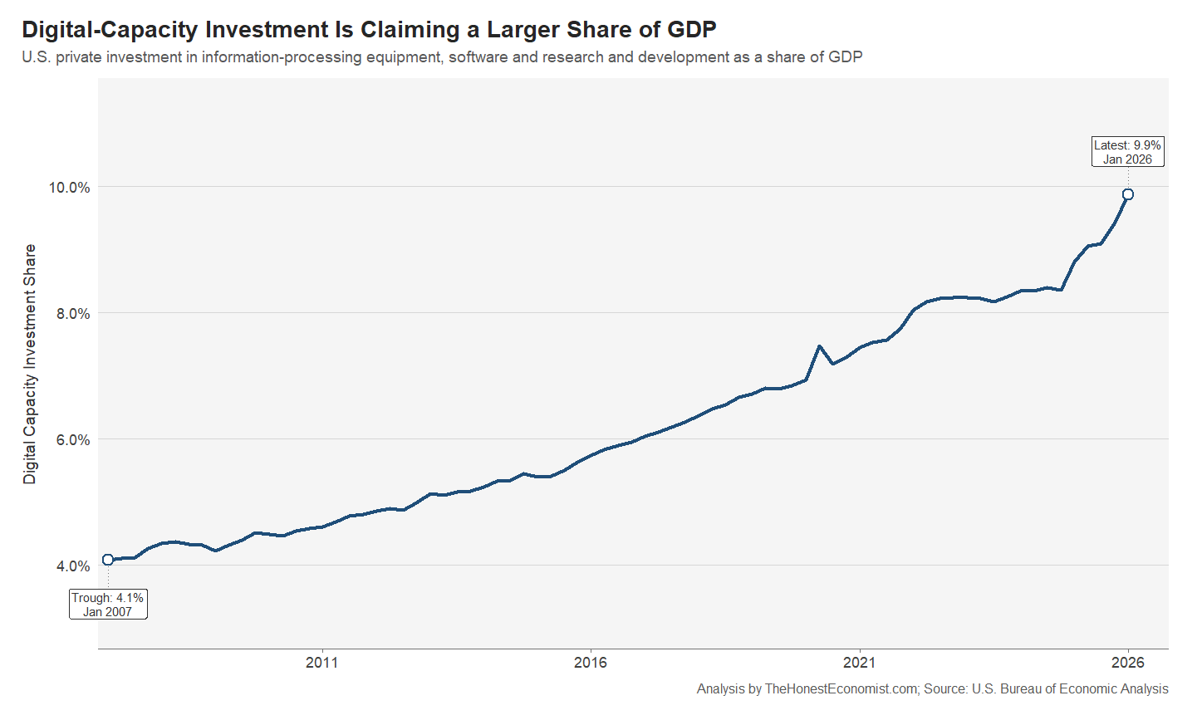
Digital-capacity investment has more than doubled, from 4.1% to 9.9% of GDP.
Nearly one dollar in ten of GDP now goes toward compute, software, and R&D.
At this scale, AI investment can (seemingly unhindered) reshape growth, infrastructure demand, and regional inequality.
The public therefore can argue for a direct stake in who pays the costs and owns the gains.
Make the Industry Cover the Costs It Creates
But perhaps, just perhaps, data-center regulation could focus on performance rather than blanket limits. For instance, developers could pay for the grid upgrades, transmission capacity, storage, water systems, and other local infrastructure directly attributable to their projects. They could even start with just a couple, if not yet the full array. In return, facilities that satisfy those requirements should receive faster and more predictable approvals.
Such rules tend to improve incentives. Developers would have stronger reasons to choose efficient cooling systems, secure reliable power, and locate projects where the underlying infrastructure can support them. Utilities would gain clearer protection against stranded investments. Local officials could evaluate projects with a more honest accounting of their costs.
Ultimately, a multibillion-dollar computing campus should not need families across town to quietly help finance its substation.
But blanket moratoria would create a different set of problems. They can delay efficient projects alongside inefficient ones and steer investment toward jurisdictions with weaker standards. Slow, uncertain permitting also favors the largest companies, since they can carry land, legal, and financing costs for longer than smaller competitors.
The better approach combines firm obligations with faster decisions. Developers that pay their way should not spend years waiting for approval because agencies lack technical standards or coordination. Regulation works best when it raises the cost of imposing harm while reducing the cost of compliance.
It all boils-down to the keystone of economics: it is not about solutions, only trade-offs!
Workplace rules require similar precision. The strongest evidence so far points to uneven productivity gains rather than immediate mass unemployment. Customer-support workers using AI assistance became roughly 15% more productive in one major field study. Software developers completed about 26% more tasks with AI support in another. Less experienced workers often gained the most.
On the flip side, more than 30% of workers could see at least half of their tasks affected by generative AI, while about 85% could see at least 10% affected. Office-support staff, business and finance employees, legal workers and several high-skill cognitive occupations face greater exposure than many physically intensive jobs.
Rules should concentrate on decisions that directly affect rights, income, and career prospects. Automated hiring, firing, pay-setting, performance evaluation, and safety-critical decisions warrant clear disclosure (if not direct human accountability). General office tools can operate under lighter requirements based on notice and the ability to challenge consequential errors.
Of course, compliance will raise costs, meaning some marginal projects will no longer pencil out. Others will proceed with better infrastructure planning and fewer hidden subsidies. Near-term investment may slow slightly, although faster approvals for compliant projects could recover part of the lost time.
Give the Public a Balance Sheet
Regulation can reduce cost shifting, yet it does not give the public a durable claim on the wealth AI creates. A modest sovereign wealth fund could provide one.
Such a fund should operate primarily as a public savings institution. Its mandate would be to capture part of the revenue associated with the AI boom, diversify it, and build fiscal capacity that survives the current investment cycle.
A sensible target would be 0.5% to 1% of GDP. At the upper end, the fund would begin at roughly $315 billion. With a 4% annual real return and no payouts, it could grow to about $466 billion after 10 years and $689 billion after 20.
Funding should come from AI-linked public revenues or levies tied to infrastructure use. General borrowing would turn the fund into a leveraged technology bet and leave taxpayers exposed if returns disappointed.
Most of the portfolio should be invested in diversified global public assets. A range of 70% to 85% would give the fund broad exposure across industries and countries. Another 5% to 15% could remain in liquid reserves. Only 10% to 20% should be available for carefully defined domestic investment.
That limited domestic sleeve could then support capabilities that private markets often underprovide, including public-interest computing capacity, cybersecurity systems, worker-transition infrastructure, and much more. Its institutional function would be narrow, and it could relieve bottlenecks and strengthen domestic capacity rather than select favored AI companies.
Heavy investment in U.S. technology stocks would undermine the fund’s purpose. Federal revenues already depend on the sector through corporate taxes, capital gains, and employment. States and municipalities carry additional exposure through infrastructure commitments and tax incentives. Concentrating the fund in the same companies would deepen the public’s dependence on a small set of firms.
Independent governance is therefore essential. The institution needs a clear mandate, professional management, transparent reporting, published performance benchmarks, and strict conflict-of-interest rules. Domestic investments should face explicit limits and public-return tests. Otherwise, the fund could become a convenient destination for politically connected projects.
Moreover, domestic spending on transmission, engineering capacity, water systems, and workforce development is more likely to build capability that remains in the United States. A carefully governed fund could convert part of a capital-intensive boom into long-lived public assets without trying to completely crowd-out private investment.
Trade a Little Speed for a Better Bargain
I will not deny that a balanced package would probably trim measured GDP growth during the first two to three years. Higher infrastructure standards, workplace protections, and compliance costs would slow some projects. Given the size of current AI investment, even modest friction would appear in national statistics.
But… an unconstrained buildout carries costs of its own (as many now know all too well). Higher utility bills, public infrastructure exposure, water system pressure, and weaker career ladders can coexist with impressive investment figures. GDP captures production more readily than it captures who absorbs the risk or owns the resulting assets. Remember that!
Workers in gateway occupations deserve particular attention. About 36% of female workers hold jobs in which generative AI could save half of task time, compared with 25% of male workers. More than 15 million workers without four-year degrees are employed in highly exposed occupations. Roughly 11 million of them hold jobs that have historically provided routes into better-paid careers.
Those workers need more than a generic, pre-recorded course after displacement occurs. They need replacement pathways with wages and bargaining power. Fund-supported programs could certainly help to finance such opportunities.
The objective should be to preserve the function of a career ladder as tasks change. Protecting every existing workflow would slow useful adoption and may leave workers stranded in roles that gradually lose value. Better transition policy would help people convert existing experience into new responsibilities before wages and opportunities collapse.
Co-investment can also offset part of the regulatory drag. Faster grid delivery and access to shared computing resources can reduce constraints that already delay projects.
But poorly designed alternatives would sacrifice growth without producing the same public benefits. Blunt regulation could slow deployment while leaving infrastructure bottlenecks intact. A large, debt-financed sovereign fund with a broad domestic mandate could invite political interference and place taxpayers behind a concentrated technology portfolio.
The United States can remain open to AI investment while imposing a more disciplined bargain. Developers would cover the infrastructure costs they create. Employers would face stronger rules when automated systems shape rights, pay, and employment. AI-linked public revenues would build a diversified national asset rather than disappearing into annual budgets.
Back in Texas, residents will still have to manage drought and heat. No sovereign fund can make water abundant. Better policy can stop treating public restraint as the quiet financing mechanism for private scale.
Sources:
Brynjolfsson, Erik, Danielle Li, and Lindsey Raymond. “Generative AI at Work.” The Quarterly Journal of Economics 140, no. 2 (May 2025): 889–942. Published February 4, 2025. https://academic.oup.com/qje/article/140/2/889/7990658.
Congressional Budget Office. Artificial Intelligence and Its Potential Effects on the Economy and the Federal Budget. May 19, 2025. https://www.cbo.gov/publication/61147.
Daly, Mary C. “The AI Moment? Possibilities, Productivity, and Policy.” Federal Reserve Bank of San Francisco Economic Letter. February 23, 2026. https://www.frbsf.org/research-and-insights/publications/economic-letter/2026/02/ai-moment-possibilities-productivity-policy/.
Fiori, Giuseppe, Colleen Lipa, and Erik Nuenninghoff. “Technology Shocks, the AI Boom, and the U.S. Current Account.” FEDS Notes. Board of Governors of the Federal Reserve System. July 14, 2026. https://www.federalreserve.gov/econres/notes/feds-notes/technology-shocks-the-ai-boomandthe-u-s-current-account-20260714.html.
Goetzel, Daniel, Mark Muro, and Shriya Methkupally. “Turning the Data Center Boom into Long-Term, Local Prosperity.” Brookings. February 5, 2026. https://www.brookings.edu/articles/turning-the-data-center-boom-into-long-term-local-prosperity/.
Grundy, Adam, Cory Breaux, and Dhanapati Khatiwoda. “AI Use at U.S. Businesses.” United States Census Bureau. May 26, 2026. https://www.census.gov/library/stories/2026/05/ai-use-businesses.html.
Kinder, Molly, Xavier de Souza Briggs, Mark Muro, and Sifan Liu. “Generative AI, the American Worker, and the Future of Work.” Brookings. October 10, 2024. https://www.brookings.edu/articles/generative-ai-the-american-worker-and-the-future-of-work/.
Lane, Charles, and Joseph W. Kane. “Confronting and Addressing Rising Energy Bills Linked to Data Centers.” Brookings. March 13, 2026. https://www.brookings.edu/articles/confronting-and-addressing-rising-energy-bills-linked-to-data-centers/.
“Monitoring AI Adoption in the U.S. Economy, Accessible Data.” FEDS Notes. Board of Governors of the Federal Reserve System. April 3, 2026. https://www.federalreserve.gov/econres/notes/feds-notes/monitoring-ai-adoption-in-the-u-s-economy-accessible-20260403.htm.
Rubinton, Hannah, and Bontu Ankit Patro. “Tracking AI’s Contribution to GDP Growth.” January 12, 2026. https://www.stlouisfed.org/on-the-economy/2026/jan/tracking-ai-contribution-gdp-growth.
Shehabi, Arman, Sarah J. Smith, Alex Hubbard, Alex Newkirk, Nuoa Lei, Md Abu Bakar Siddik, Billie Holecek, Jonathan Koomey, Eric Masanet, and Dale Sartor. 2024 United States Data Center Energy Usage Report. December 2024. https://eta-publications.lbl.gov/sites/default/files/2024-12/lbnl-2024-united-states-data-center-energy-usage-report_1.pdf.