

What Agentic AI Actually Changes
by Kent O. Bhupathi
Editor’s Note: This article has been adapted from Chapter 1 of an upcoming Market Theory AI white paper, The Economics of Bounded AI Agency.
AI;DR: Agentic AI changes enterprise economics by giving software discretion over how it pursues an objective rather than requiring every step to be predetermined. That autonomy can create substantial value by allowing systems to navigate ambiguity, resolve exceptions, reduce handoffs and adapt their approach, but it also introduces variable costs, unpredictable computational paths, additional verification requirements and new operational risks. The relevant economic unit therefore shifts from the cost of an individual model call to the total cost of completing an objective. Organisations must find an appropriate “autonomy frontier,” where the value created by additional discretion still exceeds the associated compute, oversight and failure costs. The central management challenge is consequently less about choosing the most powerful model and more about deciding how much authority a particular business problem can economically justify, then setting appropriate limits around tools, spending, actions, verification and escalation.

Imagine giving two analysts the same assignment.
The first receives a spreadsheet, a set of instructions and a deadline. The work may be complicated, but the route is mostly predetermined.
The second receives something much less specific… “figure out why sales weakened last quarter and tell me what we should do about it.” Now the analyst has choices to make. Which data matter? What should be investigated first? Is another dataset needed? Which explanation deserves testing? When is the evidence strong enough to reach a conclusion?
The second assignment may produce far more value because the analyst has been given something the first has not: discretion. It may also take twice as long, require additional resources and occasionally lead down the wrong path.
That is increasingly the economic problem hiding inside agentic AI. Enterprises are beginning to give software similar discretion.
An AI agent might need to:
Interpret an objective,
Construct a plan,
Choose among tools,
Retrieve information,
Revise its approach and eventually…
Take an action.
Each additional degree of freedom allows the system to handle more of the ambiguity that makes real business problems difficult. Yet the same freedom makes the cost of completing the task harder to predict.
More reasoning can mean more computation. More tools can mean more external costs. More autonomy can require more verification, and unsuccessful paths can create retries and rework.
The economics of agentic AI therefore begin with a deceptively simple question: how much discretion is worth delegating to software?
Discretion Is the Product
Most enterprise software was built around the comforting notion that if we can define the process clearly enough, we can tell the machine exactly what to do.
A payroll system follows rules.
A workflow engine routes a document according to predetermined conditions.
A forecasting model may be statistically sophisticated, but it usually sits inside a process whose boundaries are already known.
Inputs arrive, calculations happen and outputs go somewhere specific. But ultimately, the value of the technology comes from doing a defined thing more consistently and/or at greater scale.
Agentic systems loosen that structure. For instance, an agent can:
Be given an objective without being given every step required to achieve it,
Decide that the task needs to be decomposed into smaller tasks,
Choose which database to query, which model to invoke, which tool to call or whether to ask for more information,
Revise its plan after an unsuccessful attempt; or, sometimes,
Decide that the job is complete (whether or not you believe it so).
For the enterprise, the value lies in giving software discretion over how computation is used to pursue an objective. And this matters because much of the work inside large organisations cannot be fully specified in advance. Traditional automation works best when the path is known. Agentic AI becomes useful, truly, when it is not.
Consider an accounts-receivable process. A conventional system can flag an overdue invoice and send a reminder after thirty days. An agent might examine the customer history, identify an unresolved dispute, retrieve the relevant correspondence, compare the invoice against a contract and determine whether the issue should go to sales or finance. The value comes from allowing the system to navigate the exception rather than simply identify it.
That discretion can lower coordination costs by reducing handoffs, cutting time spent moving information between systems and keeping workflows moving when cases fall outside the expected path.
Yet discretion also makes behaviour harder to specify in advance. The moment software is allowed to decide how to solve a problem, the enterprise gives up some predictability in exchange for adaptability.
That trade is the economic foundation of agentic AI.
Every Extra Degree of Freedom Has a Cost
Suppose two customer cases look similar when they enter an agentic workflow.
The first takes three reasoning steps, runs one database query and returns a response. The second follows a longer path, searching internal records, calling an external service, retrying a failed request, comparing conflicting documents and asking another model to verify the result before a human reviewer sends part of it back for revision.
Both cases may eventually be resolved. Their resource requirements are very different.
That makes the usual way of thinking about AI cost too narrow. Pricing often focuses on tokens, API calls or units of inference, even though an enterprise deploying agents ultimately has to understand the full cost of completing the task.
A completed task can consume model inference, search, software tools, database access, external APIs, memory, orchestration and human review. Failures add retries. Ambiguous tasks add exploration. High-stakes tasks add verification. Poorly designed agents may wander through unnecessary steps before arriving at an answer they could have reached more directly.
The relevant unit of economics therefore shifts from the cost of a model call to the cost of a completed objective. And that shift creates a new source of variance.
With conventional automation, the enterprise can often estimate how much processing a transaction will require because the path is predetermined. Agentic systems can create branching computational paths. Task costs can vary sharply from one transaction to the next. Some complete cheaply, others consume far more resources and some fail outright, widening the cost distribution even when the average still looks reasonable.
For finance teams, this matters because variable behaviour creates variable expenditure.
For operations teams, longer paths can create latency and throughput problems.
For risk teams, every additional action can create another point of failure.
But for business leaders, the same autonomy that creates value can also make the system harder to govern.
There is a close organisational analogy. A manager who gives an experienced employee greater discretion does so because constant supervision is costly. The employee can adapt and solve problems without asking permission at every step. Yet budgets, approval limits and escalation rules still exist. Some decisions require a second pair of eyes.
Software delegation needs similar economic boundaries.
The objective should not be to eliminate variability. Doing so would remove much of the reason for using an agent. The objective is to determine which variability creates value and which variability is simply waste.
An agent that takes an extra five steps because a customer case is genuinely unusual may be doing exactly what we want. An agent that takes those steps because its instructions are unclear, its tool selection is poor or it repeatedly checks information it already has is consuming discretion without producing much return.
That is why agentic efficiency cannot be understood through accuracy alone…
A system can reach the correct answer and still be economically badly designed.
The Autonomy Frontier
The natural temptation in a new technology cycle is to assume that more capability is better.
More tools, longer reasoning, broader data access and less human oversight may make an agent seem more capable, but capability only matters when it improves the economic outcome.
For agentic AI, that means finding the level of autonomy appropriate to the task.
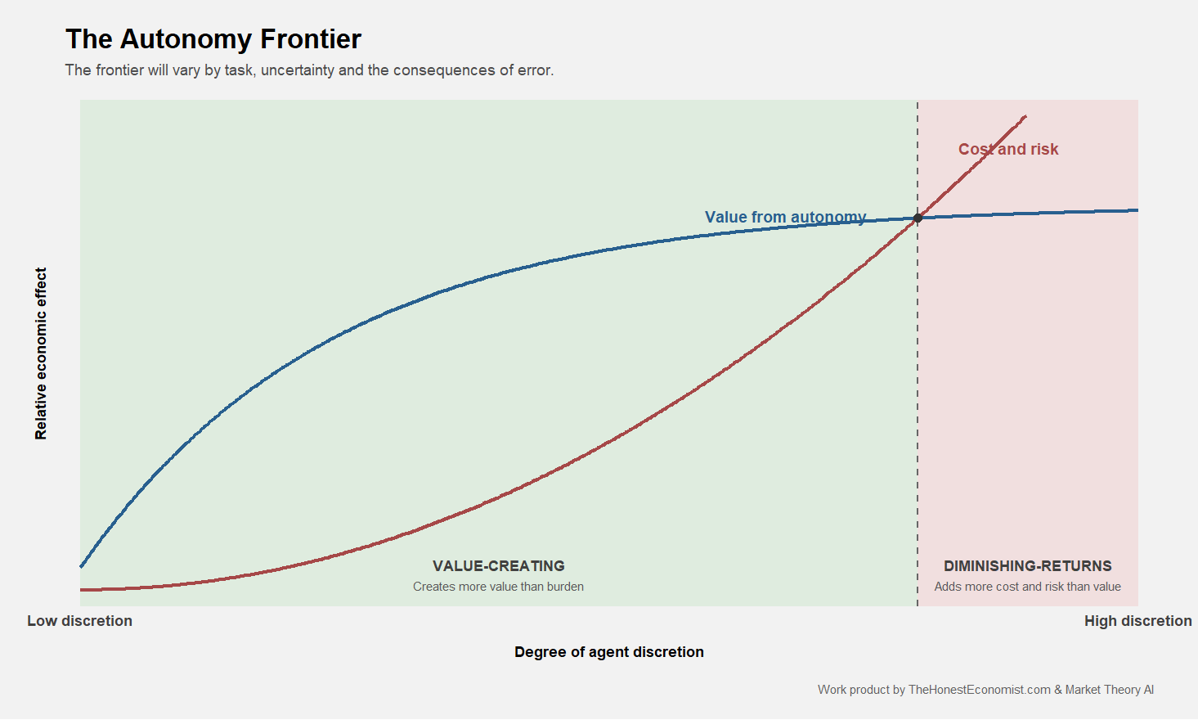
Think of this as an autonomy frontier. Additional discretion is valuable when it helps the agent resolve exceptions, reduce handoffs and adapt to changing information. Beyond a certain point, those gains begin to taper while compute costs and operational risk continue to rise.
Of course, the location of that frontier will differ across workflows.
A highly repetitive process with stable inputs may need very little autonomy. If the correct sequence is already known, allowing an agent to invent a new sequence each time can add complexity without much value. Deterministic automation may remain cheaper and/or easier to audit.
An investigative task is different, however. Research, exception handling, troubleshooting and some forms of analysis require the system to navigate uncertain paths. Much of the value comes from deciding where to look next, and constraining that judgment too tightly can reduce the agent to an expensive workflow script.
The challenge in all this is deciding how much discretion the uncertainty of the task actually requires. Framed this way, executives should look beyond model choice and focus more closely on the authority being delegated.
What can the system decide without approval?
Which tools can it use?
How much computation can it consume before stopping?
Which actions can it execute directly?
Which outputs require verification?
Under what conditions must it escalate to a person?
If the first approach fails, how many additional approaches is it allowed to try?
Seems like a lot, doesn’t it? But those are all considered fairly “simple” operating-model questions nowadays, and each has an economic consequence.
Spending limits cap resource use, tool restrictions narrow the search space, approval points add control at the cost of time and labour, and verification can reduce failure risk while raising the cost of each successful transaction. None of these choices is universally correct. Their value depends on the task, the consequences of error and the amount of ambiguity the system is expected to absorb.
In this, the key question is how much authority the system has been given and whether the resulting value justifies the cost and risk.
The Economics Come Before the Architecture
Managers have dealt with the economics of delegation for centuries, even if they rarely describe the problem in those terms.
A capable employee creates leverage because the manager does not need to specify every action. The employee interprets the objective, deals with exceptions and exercises judgment. Organisations then surround that judgment with budgets, reporting lines, controls and escalation rules because discretion has value only when it sits inside a workable system of accountability.
Agentic AI brings this familiar management problem into software. And the organisations that benefit most will be those that know where autonomy lowers coordination costs, handles ambiguity and improves decisions, and where it simply adds computation, review and opportunities for failure.
In practice, the economics of agents will depend on how well enterprises can price that discretion and set boundaries around it. So before asking how powerful an agent can become, the better question is how much discretion the underlying business problem can economically support.
Sources:
Parasuraman, R., Sheridan, T. B. & Wickens, C. D. (2000), A Model for Types and Levels of Human Interaction with Automation, IEEE Transactions on Systems, Man, and Cybernetics – Part A, 30(3).
Endsley, M. R. & Kaber, D. B. (1999), Level of Automation Effects on Performance, Situation Awareness and Workload in a Dynamic Control Task, Ergonomics, 42(3).
Aghion, P. & Tirole, J. (1997), Formal and Real Authority in Organizations, Journal of Political Economy, 105(1).
Coase, R. H. (1937), The Nature of the Firm, Economica, 4(16).
Williamson, O. E. (1979), Transaction-Cost Economics: The Governance of Contractual Relations, Journal of Law and Economics, 22(2).
Kapoor, S., Stroebl, B., Siegel, Z. S., Nadgir, N. & Narayanan, A. (2025), AI Agents That Matter, Transactions on Machine Learning Research.
Kasirzadeh, A. & Gabriel, I. (2026), Agentic Profiles for Effective AI Governance, Nature, 656.
Jørgensen, B. N. & Ma, Z. G. (2026), Governing Agentic AI in Enterprise Workflows: A Bounded-Autonomy Framework for Delegated Authority and Controlled Execution, Information, 17(9).
Liu, T. et al. (2026), Budget-Aware Tool-Use Enables Effective Agent Scaling, COLM 2026.