

Column

What Agentic AI Actually Changes
The article argues that the core economic feature of agentic AI is discretion. Unlike traditional automation, agents can interpret objectives, choose tools, revise plans and decide when a task is complete. That flexibility creates value because it lets software handle ambiguity and exceptions, but it also makes costs less predictable as reasoning, tool use, retries, verification and human review vary across tasks.
The relevant metric therefore shifts from cost per model call to cost per completed objective. The piece introduces an “autonomy frontier”: additional discretion helps until its value begins to flatten while compute costs, latency and operational risk keep rising. The goal is not maximum autonomy, but the right authority for the task. Enterprises should define tool access, spending limits, approval points, verification and escalation rules, treating agent design as an economics-of-delegation problem before an architecture problem.

Thoughts on Organizational Capital in an AI Economy
The article argues that AI coding tools are making software products converge, weakening product-layer differentiation and shifting durable advantage toward organizational capital. When interfaces, workflows, and claims can be copied quickly, the defensible assets become customer relationships, proprietary data, distribution and the internal systems that compound talent and judgment over time. Organizational capital matters because it cannot be bought through APIs or reproduced in a sprint.
It extends the argument to workers through “shape-specific human capital.” Skills become valuable only inside organizational forms built to use them. The labor market is therefore less a match between people and jobs than between people and firm structures. The piece warns that emotional validation without structural authority traps workers and concludes that firms and workers must optimize for organizational fit, authority and durable institutional fabric.

The Great Labor Opt-Out
The article argues that the surge in “founder” and “creator” identities is less a cultural shift than a labor supply response to a deteriorating outside option. With hiring stuck well below pre-pandemic levels and job search feedback collapsing, the expected value of traditional job hunting has fallen. Workers who can exit do so, not because self-employment is superior, but because the probability of receiving a viable offer has declined.
It links LinkedIn trends to Census data showing business applications far above pre-pandemic norms, then reframes the surge using “high-propensity” measures: much of the growth looks like low-payroll, freelance, or gig registration rather than classic startup dynamism. This “Haltiwanger inversion” suggests business formation now partly captures labor market blockage. The article concludes that necessity-driven self-employment can reshape B2B demand and may not lift productivity, even if AI tools lower barriers for genuine entrepreneurs.

Why the AI Explanation Took Over
The article argues that recent layoffs at profitable firms are being misread as AI-driven job replacement. The real drivers are post-pandemic demand normalization after the 2020–2022 hiring boom and the repricing of capital once rates jumped, which made boards and investors demand visible efficiency. Layoffs became a signal of discipline and margin protection, often paired with AI and data-center commitments.
AI matters mostly as framing and capital-allocation justification. Productivity gains are hard to measure, but headcount cuts show up immediately in revenue-per-employee, so executives cite AI to explain why labor costs must fall now. The cuts also reshuffle power by trimming recruiters, coordinators and middle managers while protecting core engineers and AI specialists, producing leaner, centralized firms. The article concludes this is rebalancing, not collapse, and urges leaders to base decisions on regime shifts and measurable signals, not headlines.

Why I'm Betting on Bodies, Not Just Brains
If you have been reading this blog for a bit now, you know we have been skeptical of the “AI Bubble.” Our skepticism, or at least my own, has mostly centered around the economic implementation lagging the hype. We spent the better part of 2025 watching companies buy massive amounts of GPU compute to build smarter chatbots, yet aggregate productivity statistics barely budged. (Yes, we have some data now that shows the effects of AI on productivity but not nearly as much as you would think).
While the market was distracted by the “Brain” trade (LLMs, data centers, and NVIDIA chips), you may have missed the momentum building in the “Body” trade.

AI Has Been Adopted. So Why Is Productivity Still Hard to See?
Most large companies have formal policies, enterprise licenses, internal copilots, or approved tool stacks. In many sectors, AI is already embedded in day-to-day work. If adoption alone were the constraint, we should already see it in the productivity data.
And yet, the aggregate numbers remain underwhelming.
This tension is often framed as disappointment or hype fatigue. I think it is better understood as a timing and measurement problem. In this post, we will suggest a different, slightly more uncomfortable explanation to the fears of an AI bubble.
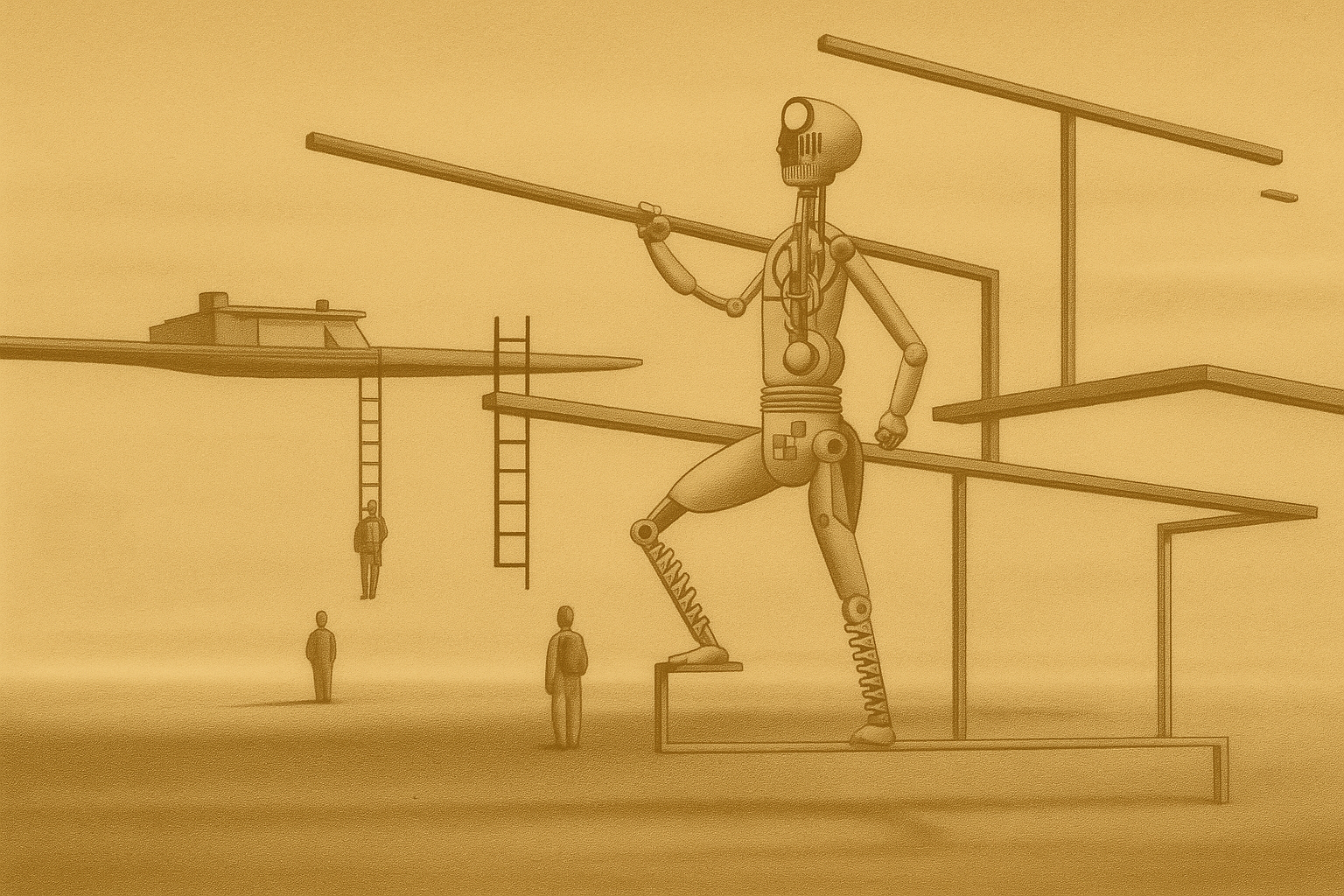
The AI Paradox: Why Your New Colleague Is Only Coming for Your Entry-Level Job
Last week, I attended a gathering of economists and data scientists from major tech companies, all focused on how technology is reshaping business and work. Practitioners swapped insights on everything from labor market trends to AI experiments. The AI revolution promises to upend how we work and this is happening against the current backdrop of the “pause economy” with hiring and investment in a cautious lull. The discussions ranged from the cooling tech job market to cutting-edge methods in causal inference and AI measurement, and deeper questions about whether AI is a substitute for human work or a “bicycle for the mind.”

Global Economy in Transition: Notes from the NABE Annual Meeting
Last week, I spent several days in Philadelphia for the Annual Meeting of the National Association for Business Economics (NABE). The event brings together economists from central banks, think tanks, corporations, and universities to assess the state of the global economy. The theme this year was Global Economy in Transition: Finding Opportunity Amid Disruption. Sessions explored the pressures shaping global business and policy: geopolitical instability, shifting trade regimes, monetary divergence, and the disruptive force of technology. There were also discussions of long-term structural issues such as climate risk, labor markets, and the balance of economic power.