

Thoughts on Organizational Capital in an AI Economy
by Mardoqueo Arteaga
AI;DR: AI is commoditizing the product layer while making organizational capital—i.e., the embedded processes and judgment that make firms function—more valuable. For companies, the moat is shifting from technical differentiation to institutional design. For workers, the labor market is becoming a matching problem between people and organizational shapes. I've watched this shift across three industries, and I think it changes how we should think about careers.
The Convergence of Product
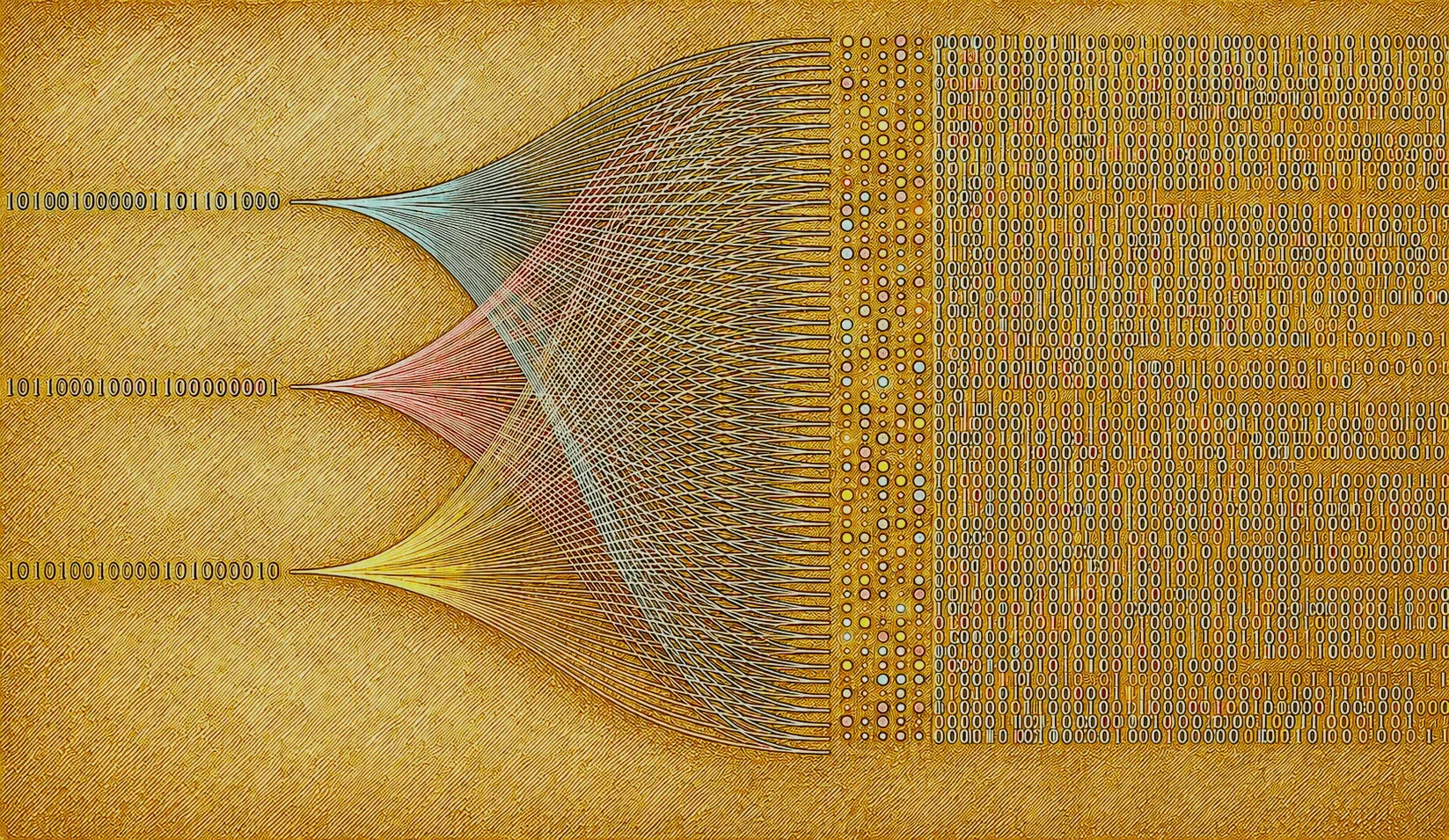
AI coding tools have compressed software development cycles from months to days. The consequence, visible across the AI software market, is rapid product convergence. As of early 2026, enterprises testing AI productivity tools reported difficulty distinguishing competing products in proof-of-concept evaluations. They cited similar interfaces, similar workflow claims, and identical category language across dozens of vendors. The five largest AI funding rounds in 2025–2026 captured over 60% of total venture capital in the sector. Early-stage funding has slowed. Investors have grown cautious about companies that lack clear differentiation from what foundation model providers will offer natively.
The convergence is structural. When a critical production input becomes cheap and widely accessible, first-mover advantages in the product layer decay. What replaces them are advantages that cannot be purchased or reproduced in a sprint: customer relationships, proprietary data, distribution, and, most durably, the organizational structures that generated the product to begin with.
The Economics of Organizational Capital
Global corporate intangible assets crossed $97 trillion in 2025, growing 23% from the prior year and representing roughly two-thirds of global GDP. Within intangibles, organizational capital is the category that matters most and is hardest to measure. A 2026 NBER working paper by Cai, Prat, and Yu defines it as a "slowly evolving intangible asset that is significantly associated with firm performance and top management's influence." Unlike R&D expenditure or software licenses, organizational capital cannot be acquired. It accumulates through the refinement of processes, the concentration of judgment, and the compounding of talent over time.
The United States invests more in organizational capital than any other country—35% of total intangible investment, compared to R&D at 37% for Japan or software at 50% for India. This distribution is not incidental. In markets where product surfaces converge rapidly, the durable advantage shifts to forms of capital that cannot be replicated by a competitor with a large API budget and a two-week sprint.
Complementarities and the Shape of the Firm
Milgrom and Roberts demonstrated that firm practices are complementary: they work in bundles, and the bundle cannot be disaggregated. A flat hierarchy requires decision rights to be pushed to the edge. Talent density compounds only if average performers cannot set the operating pace. Customer proximity matters only if customer-facing work carries real status inside the company. Copying one element in isolation produces not an approximation of the original but a different organization entirely.
AI makes the visible layer of company-building easy to imitate, and it doesn’t take much scrolling through LinkedIn to see some cases of this. The interface, the workflow, the product surface. It does not make the complementary bundle easier to assemble. If anything, it makes the bundle more consequential. When the product layer converges, the organizational layer is what remains as a source of differentiation. The shape of the firm, or how it attracts a specific kind of person, concentrates their judgment, and compounds their output over time, becomes the competitive asset.
Shape-Specific Human Capital
The same dynamic operates at the level of individual workers. Gary Becker distinguished between general human capital, portable across employers, and firm-specific human capital, valuable primarily at one company. AI is generating a third category: shape-specific human capital. A given bundle of skills and instincts may be highly productive in one organizational configuration and nearly unproductive in another.
My own trajectory across central banking, economic consulting, and tech makes the point concrete. The same bundle of policy transmission, causal inference, and client-facing narratives may read as unfocused in any single industry frame, versus as a specific analytical profile in organizations built to use it. The shape of the organization determines what counts as a credential.
The research roles that emerged at OpenAI and Anthropic illustrate it at larger scale. These positions do not follow the academic track or the corporate research lab track. They require simultaneous fluency in scientific reasoning, product development, policy considerations, and safety analysis. The role did not exist before those organizations created it; the organizational shape made a new kind of worker possible and valuable. Outside that shape, the same profile is harder to price.
The labor market is increasingly a matching problem between people and organizational shapes, not simply between people and jobs. Most workers lack exposure to enough distinct organizational types to develop a reliable sense of which shapes fit them, or whether a given struggle reflects a skills gap or a shape mismatch. Recruiting processes communicate mission and imagined futures, not the actual distribution of authority or how decisions are made under pressure. The information asymmetry at the point of hire is real and mostly unavoidable.
Structural Commitment as Signal
There is a related asymmetry in how companies engage the talent they most want to retain. Companies have learned to capture founder-level effort by offering early employees something that functions like identity: a sense of being chosen, of belonging to something consequential. The mechanism works. People absorb ambiguity like principals and work like founders when they believe in the mission.
But the mechanism has two distinct versions. In the first, emotional investment is accompanied by structural commitment: defined scope, real authority, economics that reflect what a successful outcome looks like. In the second, emotional investment is front-loaded while structural commitment is deferred. This means you end up with specialness instead of title, proximity instead of authority, or trust instead of a written mechanism. That is how someone can feel deeply valued and materially stuck at the same time. The most dangerous promises are denominated in time. Time does not announce itself as it leaves.
Being chosen is an emotional state. Being seen is a structural fact. The first can exist without the second. For workers navigating an increasingly shape-dependent labor market, the relevant question is not whether the company has chosen them but whether it has structured a place for them to succeed in.
Implications
Technical differentiation will continue to matter in AI markets, but it will decay faster than before. Organizational capital in the form of how firms hire and structure authority will decay more slowly. The companies that endure will be those that have built complementary organizational bundles others cannot easily replicate.
For workers, the question is no longer only "what skills do I have" but "what shape am I suited for." Shape-specific fit is learned through exposure rather than evaluation. A decision to take a role at an organization with a distinctive shape, or to pursue a credential designed to expand the option set rather than execute a fixed role, may carry higher long-run value than optimizing for immediate compensation. The variance in organizational shapes is increasing. So is the cost of landing in the wrong one.
For the economy, the composition of intangible investment matters as much as its level. The $97 trillion in global intangible assets represents a claim on future value creation that depends entirely on the organizations that hold it. As AI commoditizes what can be built at the product surface, the invisible layer, that institutional fabric of the firm, is where that value will either compound or dissipate.
Sources:
World Intellectual Property Organization. "The Value of Corporate Intangible Assets Worldwide." WIPO Global Innovation Index Blog, March 2026.
Cai, Wei, Andrea Prat, and Jiehang Yu. "Measuring Organizational Capital." NBER Working Paper 35039, April 2026.
WIPO-Luiss Business School. "World Intangible Investment Highlights 2025." July 2025.
Milgrom, Paul, and John Roberts. "Complementarities and Fit: Strategy, Structure, and Organizational Change in Manufacturing." Journal of Accounting and Economics, 1995.
Becker, Gary. Human Capital: A Theoretical and Empirical Analysis. University of Chicago Press, 1964.