

Booming or Just Not Yet Broken?
by Kent O. Bhupathi
A commuter does not need the NBER to know something is off.
She knows it when the gas pump clicks higher than her checking account. She knows it when the grocery total looks like a typo. She knows it before the job postings disappear, when every opening takes longer to fill, every budget meeting grows more guarded, and every manager has learned to say “uncertainty” with the solemnity of a funeral bell.
Sit with her long enough and a recession begins to sound like a lived diagnosis.
Then the news comes on, and the President says, “Our country is booming now,” despite a “mini war.” And that is where the conversation starts to strain.
See, the U.S. is not officially in recession… Payrolls are still growing. Consumers are still spending. Business investment has not vanished, especially in technology. Yet, many households and businesses are acting as if the expansion has become narrower, pricier, and less forgiving.
So, what kind of economy is this?

The most defensible answer is that the U.S. economy is still expanding, but it is not broadly booming. A boom is the kind of economy people can feel in their own margins. This one looks more like a late-cycle expansion with decent aggregate numbers and lousy distribution.
Phrased differently, it is alive, but far from comfortable.
Growth Without Breathing Room
The official case for strength starts with labor. In March 2026, pre-adjusted nonfarm payrolls rose by 178,000, the unemployment rate held at 4.3%, and average hourly earnings were up 3.5% from a year earlier. Initial jobless claims fell to 189,000 in the week ending April 25. Those are not layoff-wave numbers.
Output is still positive, too. Real GDP supposedly grew at a 2.0% annualized rate in the first quarter. Real final sales to private domestic purchasers rose 2.5%, which is a cleaner read on underlying private demand because it strips out some of GDP’s noisier pieces. Additionally, consumer spending increased 1.6%, and business investment rose 8.7%.
Taken together, this explains why official institutions have not sounded any recession alarms. The Federal Reserve’s April 29 statement said economic activity was “expanding at a solid pace,” while also warning that inflation remained elevated and Middle East developments had created a high level of uncertainty.
However, that phrase, “solid pace,” is doing a lot of work. It describes the aggregate economy. It does not describe the emotional economy of households paying more for fuel, carrying expensive debt, and wondering why “strong” feels so much like “stretched.”
A “Recession” Is Measured, Not Felt
The NBER does not declare a recession because people are anxious, inflation is painful, or a few indicators look ugly. Its Business Cycle Dating Committee looks for, what it considers, a significant decline in economic activity that is broad, sustained, and visible across measures. It is, however, not a transparent definition. And all one can hope is that the bar is reasonable.
But the U.S. has not yet crossed that bar. Final demand has not rolled over. Payrolls are still growing. Exports and investment are still contributing. The consumer has slowed, but has not stopped.
Even a Sahm-rule-style check does not yet scream recession. The three-month average unemployment rate from January through March was about 4.3%, roughly 0.33 percentage point above the prior 12-month low. That remains below the 0.5 percentage point increase commonly associated with recession signals.
The same discipline applies to more sensitive gauges. The Brave-Butters-Kelley Coincident Index was weak at -0.2 in March, but still near trend (rather than the rough recession danger zone below -1). Even by our own definitions, the economy has not crossed into recession, though the probability consistently remains elevated.
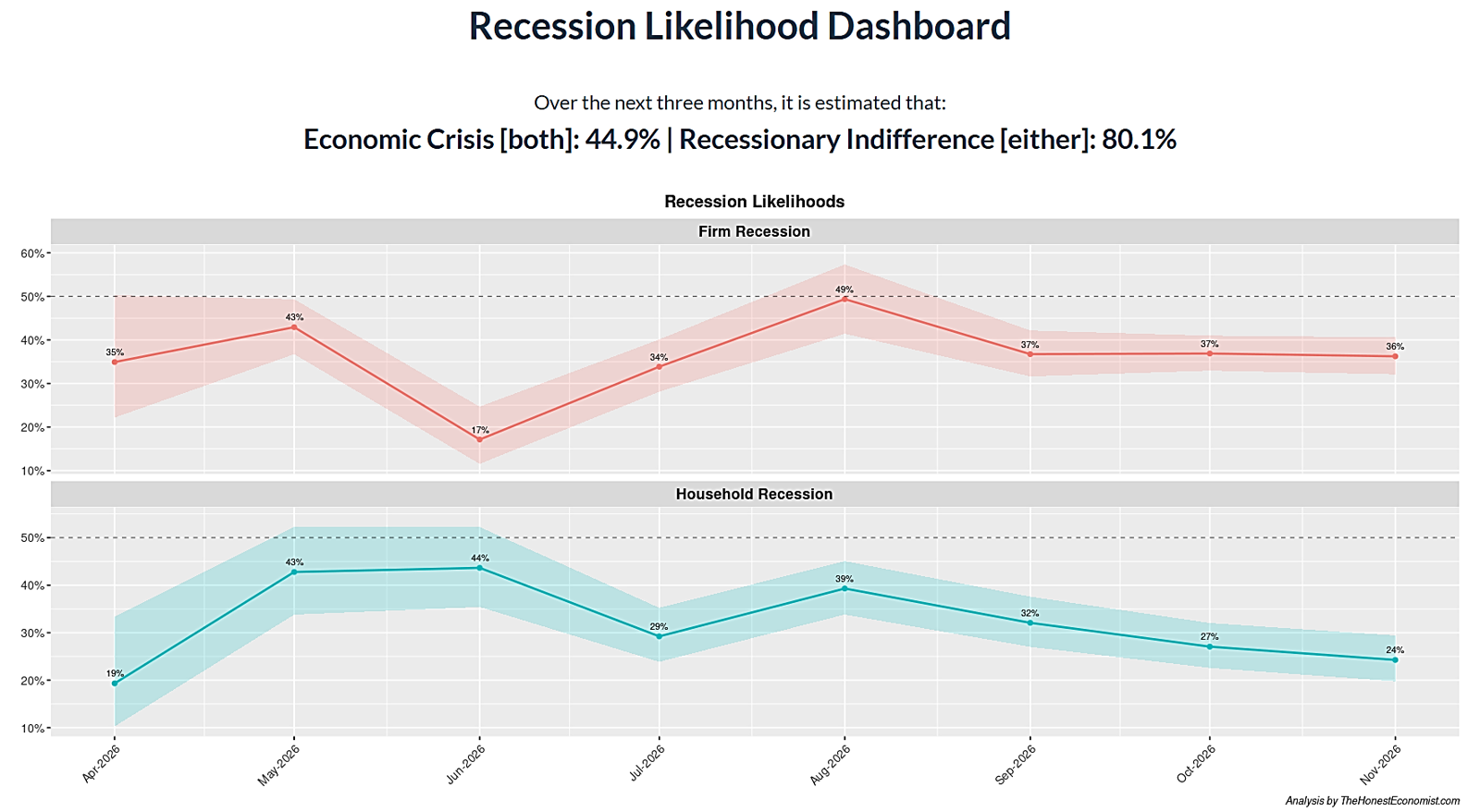
From this, it is important to remember that the country can feel strained before the official economy contracts. The pain often arrives before the label.
The Pressure Points Are Jobs, Credit and Affordability
The headline labor market has held up. But the experience underneath it is less reassuring.
Long-term unemployment reached 1.8 million in March, up 322,000 from a year earlier, and long-term unemployed workers accounted for 25.4% of all unemployed people. Average weeks unemployed rose to 25.3 in March from 22.9 a year earlier. Layoffs are not surging, but the labor market has lost some of its snap. People who lose work are taking longer to get back in.
Income is not giving households much protection. Real average hourly earnings were up only 0.3% over the year. Real disposable personal income fell 0.1% in March, and the saving rate was only 3.6%. That is not a household sector with much room for error.
Credit tells the same story from another angle. Consumer-loan delinquencies at commercial banks rose to 2.62% in the fourth quarter of 2025, up from 2.23% in early 2023. Commercial-and-industrial loan delinquencies rose to 1.23% from 0.94% over the same period. Broader household delinquency worsened to 4.8% of outstanding debt.
This is what late-cycle fragility looks like… while the system is still moving, more people are moving through it with less room to slip.
Oil Prices Travel Faster than Armies
The Iran conflict does not have to shut down the U.S. economy to damage it. The main channel is energy.
The Strait of Hormuz remains one of the world’s most important energy chokepoints. The Energy Information Administration says oil flows through Hormuz averaged 20.9 million barrels per day in 2023, about 20% of global petroleum liquids consumption. Roughly one-fifth of global LNG trade also passed through the strait.
The U.S., however, does not rely heavily on direct crude imports from that route. In the first half of 2025, the U.S. imported only about 0.4 million barrels per day of crude and condensate from Persian Gulf countries through Hormuz. This is equal to about 7% of U.S. crude imports and about 2% of U.S. petroleum liquids consumption.
That may sound reassuring, but oil does not price itself within American borders. Global crude markets still set the terms, which means U.S. drivers remain exposed even when domestic production is strong.
That channel is already visible. West Texas Intermediate crude averaged about $60 per barrel in January, $65 in February, and then jumped to $91 in March. Brent crude settled at $94 per barrel on March 9, up about 50% from the start of 2026, and spot data later showed Brent at $114 and WTI at $100 on April 27. AAA’s national average gasoline price reached $4.46 per gallon on May 4, up nearly 30 cents in one week…
For households, that is a tax increase with worse branding. And for businesses, it is a margin squeeze. (see Mardoqueo Arteaga, March 2026)
The Fed Has Little Room for Error
Oil shocks create one of the worst policy problems because they can lift inflation and weaken growth at the same time.
The Fed’s March meeting minutes said the Middle East conflict had caused sharp increases in energy prices and raised serious questions about the macro outlook. Participants noted that a prolonged conflict could keep inflation elevated for longer. Many said persistent oil-price increases could justify rate hikes to re-anchor inflation. Most also worried that a larger oil shock could soften labor markets and justify cuts.
For the Fed, that offers no rate-cut roadmap, only a steering wheel slick with grease.
By April 29, the Fed’s statement said inflation was elevated partly because of higher global energy prices and that Middle East developments were contributing to uncertainty. Reuters later reported that Minneapolis Fed President Kashkari warned the Iran war limits the Fed’s ability to provide rate guidance.
The longer the conflict lasts, the greater the risk of higher inflation and economic damage.
The data are already moving in the wrong direction. Headline PCE inflation accelerated from 2.8% in February to 3.5% in March. Core PCE rose from 3.0% to 3.2%. The first-quarter GDP report showed the PCE price index rising at a 4.5% annualized rate, with core PCE up 4.3%.
A clean demand slump lets the Fed cut. A clean inflation problem lets the Fed hike. A war-driven oil shock gives the Fed both problems at once!
Growth Is Pooling in Asset Markets
The economy can look sturdy from the top down because asset owners are doing better than cash-flow households.
Federal Reserve distributional accounts show that at the end of 2025, the top 10% of households by wealth held roughly $50.4 trillion of $57.7 trillion in corporate equities and mutual fund shares, about 87%. The bottom half held about $0.62 trillion, roughly 1%.
So, when household wealth supports spending, that support is heavily concentrated. When equities rebound, the benefits are not evenly mailed across America. When business investment is strong because of technology, such as software, AI, and data-centers, the gains accrue first to firms, workers, and investors tied to those sectors.
Meanwhile, retail sales can look strong partly because people are paying more for the same necessities. Census reported March retail sales rose 1.7% to $752.1 billion, but those figures are not adjusted for price changes. When gasoline prices jump, nominal spending can rise even as households become less comfortable.
That is how an economy can look strong from 30,000 feet and feel brittle at eye-level.
Asset owners see resilience. Commuters see gas. Executives see capital expenditure. And renters see no savings cushion.
Doesn’t sound all that sustainable, does it?
The Final Straw Need Not Be Heavy
The Iran conflict has not, by itself, pushed the U.S. into recession. But that is too low a bar for analysis. The better question is whether it adds pressure to the exact places where the economy is already vulnerable.
Guess what? It does.
Higher gasoline prices hit household purchasing power.
Higher shipping and insurance costs raise business expenses.
Higher oil prices complicate the inflation outlook.
Higher uncertainty makes firms more cautious.
Higher Treasury term premiums and tighter lending standards keep pressure on borrowers…
And none of these has to produce an immediate collapse to matter.
The IMF has already cut its growth outlook because of war-driven energy shocks and supply disruptions, warning that if the conflict worsens and oil stays above $100 through 2027, the world economy would move to recession. Fed minutes also pointed to weaker Treasury market liquidity, higher term premiums, and stress in corners of credit, including leveraged loans and some private-credit funds.
This, dear readers, is a compounding problem.
Neither Boom nor Recession
So will the Iran conflict / war / thing be the straw that breaks the camel’s back?
Not inevitably, no. As of May 5, the highest-confidence conclusion is narrower. The U.S. is still expanding, but the expansion is increasingly expensive and exposed. The Iran “mini-war” is reshaping the expansion without breaking it outright, adding stagflationary pressure, widening inequalities, and leaving the Fed with less room to maneuver.
That means the “booming” claim is accurate only for certain slices of the country. It works better for asset-heavy households, energy producers, some defense-linked activity, and firms positioned around capital-intensive technology investment. It works less well for, well…
Commuters,
Renters,
Borrowers,
Small businesses,
Fuel-intensive employers,
And, frankly, anyone trying to rebuild savings while gasoline, insurance, groceries, and financing costs keep moving the wrong way.
Sounds like you at all?
So, yeah… the NBER has not called a recession because the economy has not yet met their cryptic standards. Meanwhile, the American public remains uneasy because a great many households have already grossly exceeded their own stress tests.
Unfortunately, both things can be true. But the absence of recession is not proof of a boom. It may simply mean the economy has not yet broken.
Sources:
American Automobile Association. “AAA Gas Prices.” Accessed May 1, 2026. https://gasprices.aaa.com/.
Board of Governors of the Federal Reserve System. “Charge-Off and Delinquency Rates on Loans and Leases at Commercial Banks.” February 24, 2026. https://www.federalreserve.gov/releases/Chargeoff/delallsa.htm.
Board of Governors of the Federal Reserve System. “Minutes of the Federal Open Market Committee, March 17–18, 2026.” https://www.federalreserve.gov/monetarypolicy/fomcminutes20260318.htm.
Board of Governors of the Federal Reserve System. “Industrial Production and Capacity Utilization—G.17.” April 16, 2026. https://www.federalreserve.gov/releases/g17/Current/.
Board of Governors of the Federal Reserve System. “Federal Reserve Issues FOMC Statement.” April 29, 2026. https://www.federalreserve.gov/newsevents/pressreleases/monetary20260429a.htm.
Board of Governors of the Federal Reserve System. “Senior Loan Officer Opinion Survey on Bank Lending Practices.” May 4, 2026. https://www.federalreserve.gov/data/sloos/sloos-202604.htm.
Chavez-Dreyfuss, Gertrude. “US Bond Markets Diverge as Middle East Conflict Tests Fed Outlook.” Reuters, April 28, 2026. https://www.kitco.com/news/off-the-wire/2026-04-28/us-bond-markets-diverge-middle-east-conflict-tests-fed-outlook.
The Conference Board. “US Consumer Confidence.” April 28, 2026. https://www.conference-board.org/topics/consumer-confidence/.
Federal Reserve Bank of New York. Quarterly Report on Household Debt and Credit, 2025: Q4. February 2026. https://www.newyorkfed.org/medialibrary/interactives/householdcredit/data/pdf/HHDC_2025Q4.
Indiana University, Indiana Business Research Center. “The BBKI: Brave-Butters-Kelley Indexes.” May 4, 2026. https://www.ibrc.indiana.edu/bbki/.
Kilian, Lutz, Michael Plante, and Alexander W. Richter. “What the Closure of the Strait of Hormuz Means for the Global Economy.” Federal Reserve Bank of Dallas, March 20, 2026. https://www.dallasfed.org/research/economics/2026/0320.
Lawder, David. “IMF Cuts Growth Outlook, Warns of Potential Global Recession if Iran War Worsens.” Yahoo Finance, April 14, 2026. https://ca.finance.yahoo.com/news/imf-cuts-growth-outlook-warns-134445713.html
Longley, Alex. “Shipping Insurance Costs to Cross Hormuz Soar After Vessel Attacks.” Insurance Journal, March 17, 2026. https://www.insurancejournal.com/news/international/2026/03/17/862173.htm.
National Bureau of Economic Research. “Business Cycle Dating.” https://www.nber.org/research/business-cycle-dating.
U.S. Bureau of Economic Analysis. “Gross Domestic Product (Advance Estimate), 1st Quarter 2026.” April 30, 2026. https://www.bea.gov/news/2026/gdp-advance-estimate-1st-quarter-2026.
U.S. Bureau of Economic Analysis. “Personal Income and Outlays, March 2026.” April 30, 2026. https://www.bea.gov/news/2026/personal-income-and-outlays-march-2026.
U.S. Bureau of Economic Analysis. “Personal Consumption Expenditures Price Index.” April 30, 2026. https://www.bea.gov/data/personal-consumption-expenditures-price-index.
U.S. Bureau of Labor Statistics. “Employment Situation Summary.” April 3, 2026. https://www.bls.gov/news.release/empsit.nr0.htm.
U.S. Bureau of Labor Statistics. “Alternative Measures of Labor Underutilization.” https://www.bls.gov/charts/employment-situation/alternative-measures-of-labor-underutilization.htm.
U.S. Bureau of Labor Statistics. The Economics Daily. https://www.bls.gov/opub/ted/2026/real-average-hourly-earnings-increased-0-3-percent-from-march-2025-to-march-2026.htm.
U.S. Census Bureau. “Advance Monthly Sales for Retail and Food Services.” April 21, 2026. https://www.census.gov/retail/sales.html.
U.S. Census Bureau. “Monthly New Residential Construction, March 2026.” April 29, 2026. https://www.census.gov/construction/nrc/current/index.html.
U.S. Census Bureau. “Advance Economic Indicators Report, March 2026.” April 29, 2026. https://www.census.gov/econ/indicators/current/index.html.
U.S. Energy Information Administration. “Fewer Tankers Transit the Red Sea in 2024.” October 11, 2024. https://www.eia.gov/todayinenergy/detail.php?id=63446.
U.S. Energy Information Administration. “EIA Releases Latest Short-Term Energy Outlook amid Middle East Conflict.” March 10, 2026. https://www.eia.gov/pressroom/releases/press584.php.
U.S. Energy Information Administration. “Petroleum & Other Liquids.” April 29, 2026. https://www.eia.gov/dnav/pet/hist/LeafHandler.ashx?f=M&n=PET&s=RWTC.
U.S. Energy Information Administration. Short-Term Energy Outlook. April 2026. https://www.eia.gov/outlooks/steo/pdf/steo_text.pdf.
Wiseman, Paul. “U.S. Economy Grew 2% from January-March, Recovering from Federal Shutdown; Iran War Clouds Outlook.” Associated Press, April 30, 2026. https://apnews.com/article/gdp-economic-growth-inflation-iran-2e09bd656cd8ad1f9999c3cb7aac75e1.