

Which Half of Your Resume Is AI Making More Valuable?
by Mardoqueo Arteaga
AI;DR: The dominant career advice of the moment is to learn AI skills or be left behind. The data complicates that. The fastest-growing skills in the U.S. are splitting into two parallel tracks, one where we have technical AI capabilities and deeply human ones growing at nearly the same rate. AI is simultaneously commoditizing one half of your resume and inflating the value of the other. The question that matters for all workers today is not whether you are learning AI, but rather which half of your skill set you have been investing in.

For the past two years, the prevailing message to anyone thinking about their career has been singular and urgent: develop AI skills, or risk obsolescence. It is sound advice as far as it goes, and has been met with reactions of evangelism and criticism alike. But it describes only half of what the data actually shows, and the missing half changes the conclusion.
LinkedIn's 2026 Skills on the Rise report, which ranks the fastest-growing skills in the U.S. by measuring year-over-year growth in both skill acquisition and hiring success, found that the skills accelerating most quickly fall into two distinct categories. The first is what everyone expects: AI engineering, prompt engineering, AI implementation, and data governance. The second is what fewer people anticipated: executive and stakeholder communication, leadership and people management, cross-functional collaboration, and relationship development. Both categories are growing at nearly the same pace.
This is not a coincidence, and it is not noise. It reflects a structural feature of how AI is reshaping the value of human work, a change that we have not seen in the labor market for over a generation. The same technology that is making one set of capabilities abundant is making another set scarce, and the market is repricing both at the same time. For my economist friends, the market is trying to clear!
The Mechanism Beneath the Split
To understand why the skills market is bifurcating, it helps to separate work into two kinds of tasks. The first kind is structured, repeatable, and legible, many of which we can easily point to: drafting standard code, processing data, producing routine reports, generating first-draft content. Many of these are also standard for entry level workers. The second kind is contextual, relational, and judgment-dependent: persuading a skeptical executive, navigating a cross-functional dispute, deciding which problem is worth solving, building the trust that makes a difficult decision actionable.
AI is extraordinarily good at the first kind and largely incapable of the second. The consequence is a divergence in value that is now visible in the data. A Harvard Business School study analyzing nearly all U.S. job postings from 2019 through March 2025 found that demand for structured and repetitive cognitive roles declined 13 percent following the launch of ChatGPT, while demand for analytical, creative, and leadership-intensive work grew 20 percent over the same period.
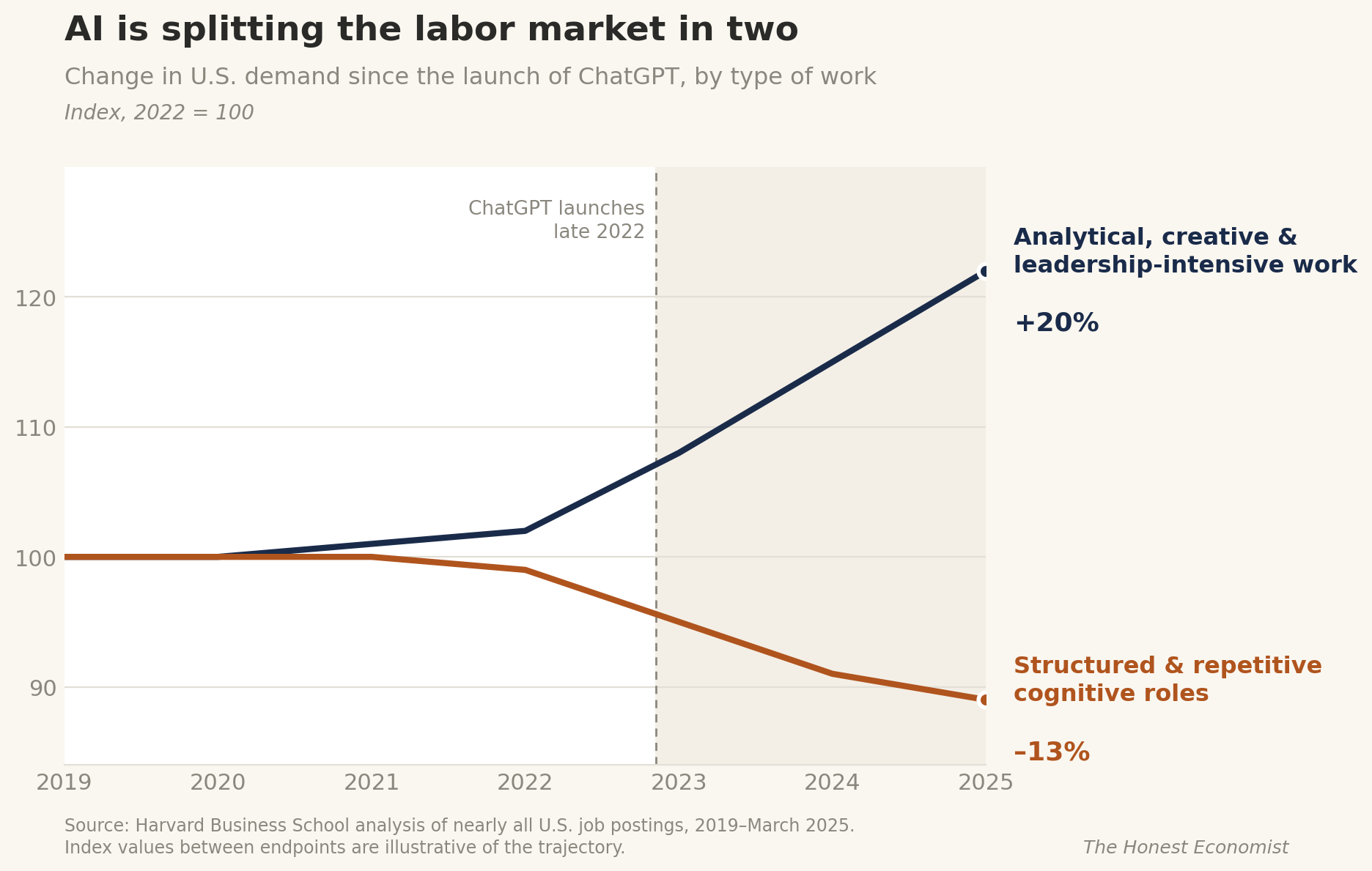
The economic logic is straightforward: when a productive input becomes abundant, its price falls. AI has made competent execution of structured cognitive tasks abundant, and the market value of those tasks is declining accordingly. Meanwhile, the capabilities that complement AI rather than compete with it—judgment, persuasion, the ability to orchestrate work across people and systems (what many have dubbed systems thinking)—have become the binding constraint on what organizations can accomplish. Scarcity raises their price.
What the Layoffs Reveal
The clearest evidence of this divergence comes not from what companies say but from whom they choose to keep. Out of the many companies that laid workers off in early 2026, Morgan Stanley cut roughly 2,500 roles (or about 3 percent of its global workforce) despite reporting record revenue of $70.6 billion for the prior year. Their reductions spanned investment banking, trading, and operations. One group was conspicuously excluded: financial advisors. The client relationships those advisors had built over years of working through market cycles and difficult conversations could not be reconstructed by a model, and the firm acted accordingly.
I’m sure there are many other examples (perhaps most conspicuously in tech given their lions’s share of layoffs), but this and any similar example is the bifurcation made concrete. The roles most exposed to reduction are those whose output AI can now approximate, while the roles most protected are those built on accumulated human judgment and relationship. A firm under pressure to cut costs will not cut indiscriminately but rather where machines can substitute, opting to protect where they cannot (to my AI evangelists, ‘not yet, anyways’). The pattern of those decisions is a map of where human value is migrating.
The Investment Question
For an individual navigating this market, the implication is not the one the prevailing advice suggests. The instruction to "learn AI" is incomplete because it treats AI fluency as the destination rather than as one of two things worth developing. The more useful framing is to recognize that your resume has two halves, and AI is moving their values in opposite directions.
The first half is the set of structured, executional skills that once formed the core of professional competence: the ability to produce the standard output of your field reliably and well. AI is steadily lowering the market value of this half. It remains necessary since you cannot orchestrate work you do not understand, but it is no longer sufficient, and it is no longer where differentiation lives. One need not look very far to the world of academic publishing to see that even what was once considered the highest signal of professional, instructive competence in a given field is also not protected from the effects of AI.
The second half of skills is the set of capabilities that AI cannot replicate and increasingly depends upon: the judgment to know which problems matter, the communication to move people toward a decision, the relational capital that makes collaboration possible, and the strategic sense to direct AI tools toward outcomes that are actually valuable. This half is appreciating. (Disclaimer: I leave out the fact that founders and entrepreneurs are also seeing a boom, though one could argue that these types of workers also exhibit these kinds of skills.)
The mistake is to read the AI moment as a signal to invest exclusively in the first half, or to become marginally faster at execution that AI is already making cheap. Though tempting and perhaps augmented by the endless corporate language to “master AI” and that “everyone should be a builder”, the data suggests the opposite. The durable returns are accruing to those who pair enough technical fluency to work alongside AI with the human capabilities that AI cannot supply. Through a sports lens, one can say that technical fluency is the entry ticket while human capabilities are the differentiator.
None of this means technical skill is unimportant; an inability to work with AI tools is its own form of obsolescence. But the framing that dominates career conversations that I’ve been reading more and more, that of “learn AI or be left behind”, captures only one side of a two-sided shift. The fuller question, and the one worth asking about your own trajectory, is which half of your resume you have been building. Because the market is now paying very different prices for each.
Sources:
LinkedIn. "Skills on the Rise 2026." LinkedIn Economic Graph, February 2026.
Harvard Business School. Study of U.S. job postings, 2019–March 2025, as reported in Inc., June 2026.
Brynjolfsson, Erik, et al. "Canaries in the Coal Mine: Early-Career Workers and Generative AI." Stanford Digital Economy Lab, November 2025.
Morgan Stanley workforce reductions, as reported Q1 2026.