

by Kent O. Bhupathi
Editor’s Note: This article has been adapted from Chapter 2 of an upcoming Market Theory AI white paper, The Economics of Bounded AI Agency.
AI;DR: Cheap AI models do not necessarily produce cheap work. This article examines why enterprises should measure cost per accepted outcome, accounting for human oversight, failed attempts, corrections, and external tools rather than relying on token or API costs alone. Agentic AI introduces further uncertainty because autonomous systems determine how much computation to consume, creating unpredictable operating costs. Ultimately, economic efficiency requires balancing an agent’s autonomy and expenditure against the business value of completed, usable work.

Now imagine an operations team reviewing the first month of a new AI deployment. For anyone unfamiliar with enterprise AI, just think of a business evaluating some newly installed software.
The numbers initially look excellent. Thousands of tasks have passed through the system, the model costs surprisingly little to run, and the API bill (the cost of connecting to and using the AI model) comes in comfortably below the cost of the human work it was meant to replace.
Then somebody asks a few awkward questions…
How many outputs had to be checked by an employee? How many failed runs were repeated? How much staff time went into correcting answers that were nearly right but could not actually be used? Suddenly, the neat little model bill begins to look less informative.
A couple of weeks ago, in What Agentic AI Actually Changes, I explored how giving AI systems discretion over their own actions introduces new economic trade-offs. Greater autonomy can make software considerably more useful, although the costs and risks of exercising that freedom must be managed.
So, even when an AI system completes its assigned work successfully, the cost of obtaining a result the business can actually use remains a separate economic question.
AI has made the price of computation unusually easy to observe, and that visibility can distort how enterprises evaluate their investments. Tokens can be counted and model calls priced almost instantly, while the human supervision, repeated attempts and corrections needed to produce acceptable work are considerably harder to capture.
Cost per accepted outcome therefore provides a more meaningful economic measure, although understanding it also requires examining how widely costs can vary when an AI system performs essentially the same task.
The Wrong Denominator
The appeal of token economics is obvious, since tokens have real-world prices. API calls appear on invoices and cloud usage can be monitored down to the transaction. Plus, managers like numbers that arrive cleanly labeled, and AI has supplied an abundance of them.
The problem is that enterprises do not ultimately buy tokens, but the actual work.
Suppose an AI system drafts a financial report for $2 worth of inference. That sounds cheap. If an analyst then spends forty minutes correcting figures, checking citations, and restructuring the conclusion before the report can be sent, the economically relevant cost is no longer $2. The model invocation was only one input into producing something the organization could actually use.
The same logic works in the opposite direction. For instance, a system might consume considerably more inference, search multiple databases, and invoke several specialist tools. Its computational bill looks expensive. Yet if that system resolves a process that previously required hours of professional labor, the expensive model may be the cheaper way to produce the outcome.
This is why the useful denominator is cost per accepted outcome.
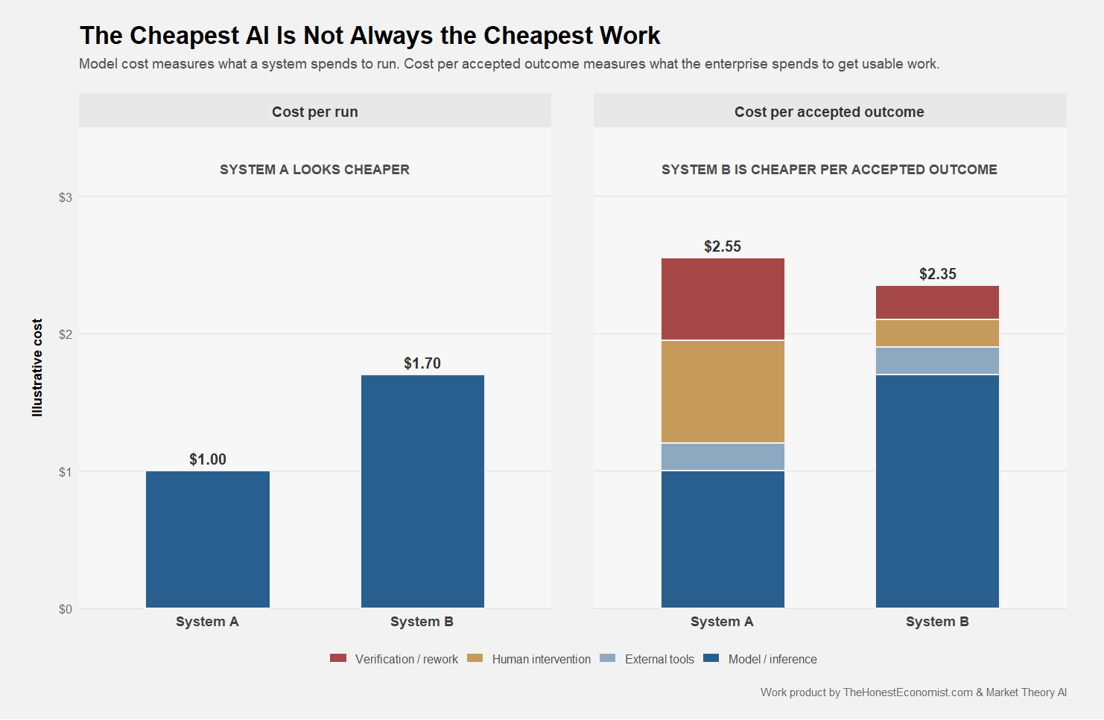
Accepted matters. A workflow does not become economically successful merely because an agent announces that it has finished. The result must satisfy whatever business standard makes the task genuinely complete. A customer issue must be resolved rather than merely answered. A reconciliation must balance. A research product must be reliable enough to use. A software fix has to work.
Consider two systems attempting the same task. The first costs $1 every time it runs but succeeds only half the time. The second costs $1.70 and succeeds almost every time. Judged by execution cost, the $1 system wins easily. Judged by the amount the enterprise must spend to obtain a usable result, the comparison changes quickly. Failed attempts bring retries, staff intervention, delay and correction. The apparent bargain begins to look less attractive.
This is also why a model bill cannot describe the full economics of an agentic workflow…
Work may consume inference, databases, search, SaaS tools, APIs and orchestration. Humans may approve decisions, supply missing context, or correct mistakes. Outputs may require verification. Failures may create downstream costs well beyond the AI system itself. The exact mix will differ by workflow, which is precisely why talking about the generic “cost of an AI agent” is so unhelpful.
Once the denominator becomes completed work, AI starts to look less like a software-pricing problem and more like an operating-economics problem.
When the AI Decides How Much to Spend
Agentic AI systems complicate the picture further because the amount of work required to produce an outcome is no longer entirely fixed in advance.
Traditional software usually follows a path someone has already designed. A transaction enters, prescribed steps occur and an output emerges. Simple enough! The marginal cost of repeating that process is therefore reasonably predictable.
An agent can behave quite differently. It may inspect the task, decide that more information is needed, query a database, dislike the result, search elsewhere, invoke another tool, and reconsider its plan. If a tool call fails, it may retry. If the evidence conflicts, it may continue reasoning. The amount of computation emerges partly from the route the system chooses while solving the problem.
This introduces a degree of unit-cost uncertainty that businesses have long encountered in labor and supply chains but have rarely had to consider in software.
An agent may complete one task quickly yet consume far more resources on a seemingly similar one when an unexpected exception leads it to explore alternative approaches, keeping it active well beyond the point where a simpler system would have stopped.
A 2026 study of agentic coding tasks found that repeated runs on the same task could vary by as much as 30 times in total token consumption, even though higher expenditure did not consistently improve performance. Results often leveled off at intermediate spending levels, suggesting that additional computation could accumulate without producing commensurate gains. Although the study is specific to coding agents and does not establish a general benchmark for enterprise workflows, it illustrates how substantially computational costs can diverge even when the underlying task remains unchanged.
That makes averages potentially misleading!
So now suppose an agent completes 1,000 instances of a workflow at an average cost of $4. Management could reasonably conclude that the unit economics are attractive. But perhaps almost every transaction costs around $4. Or perhaps 900 transactions cost $1 while a small number consume $30, $50 or $100.
Those are not the same operating model!
Average costs can obscure the financial consequences of unusually expensive executions, particularly as deployment scales. Even when two systems have nearly identical costs under typical conditions, differences in the frequency and severity of expensive runs can create substantially different exposures, complicating financial forecasts, eroding service margins, and undermining pricing models built around an assumed cost per transaction.
From this, the managerial question needs to expand accordingly. What does a normal execution cost? What does an accepted outcome cost? And, how expensive can the unusual cases become?
For me, that last question matters because autonomy changes more than the possible level of AI expenditure… It makes costs harder to predict by giving agents discretion over how much effort to devote to a task, whether through additional searches, repeated attempts, or prolonged reasoning. That flexibility can be precisely what allows an agent to solve a difficult problem, but it can also keep the system working, and spending, long after further effort has ceased to be productive.
Spend More When More Is Worth It
None of this means enterprises should force agents to use as little computation as possible.
That would most certainly replace one bad metric with another. And some work genuinely benefits from expensive reasoning.
Research illustrates why greater computational expenditure can sometimes be justified, particularly when the path to a reliable answer is unclear at the outset. An agent may need to pursue several lines of inquiry, evaluate conflicting evidence, and change direction as its understanding develops, consuming considerably more resources than a simple chat interaction while ultimately producing a far more useful result.
For example, Anthropic has described this directly in its own multi-agent research system. Its agents reportedly use around four times as many tokens as ordinary chat interactions, while multi-agent systems can use roughly fifteen times as many. The company’s own economic argument is that this higher expenditure can make sense when the value of the research task is large enough to justify the additional performance.
That distinction then separates technical efficiency from economic efficiency.
Technical efficiency asks whether the system could accomplish the same computational task using fewer resources.
Economic efficiency asks whether spending additional resources creates enough additional business value to justify doing so.
Enterprises ultimately care about the second.
A $20 human intervention that prevents $200 of wasted computation is sensible. Inserting that same $20 checkpoint into every routine transaction may destroy the economics of the workflow. An additional reasoning cycle that catches a material error may be cheap insurance. Ten unnecessary searches after the system already has enough information are simply waste.
The management problem is therefore to create boundaries around how an agent spends.
Token budgets offer a crude means of controlling expenditure, although the actual cost of running an agent depends heavily on the discretion it has throughout a workflow. Rules governing its access to external tools, requirements for verification, and the circumstances under which it must seek human intervention or stop working ultimately determine how much additional computation, tooling, and human attention the system can consume.
Seen this way, many familiar AI governance controls have an economic role as well as a risk-management role. They prevent open-ended discretion from becoming open-ended expenditure.
Every additional increment of computation or human attention should be justified by an expected improvement in the business outcome whose value exceeds the additional cost, a straightforward economic principle that is considerably harder to enforce in practice.
That is a very different ambition from building the cheapest possible agent. It is also different from giving the most capable system an unlimited budget and assuming more intelligence must produce better economics.
Cheap Models Do Not Guarantee Cheap Work
Let us return to that operations team reviewing its first month of AI deployment.
The original API bill was accurate as far as it went, although it captured only a fraction of what the business was actually spending. Measuring the cost of an accepted outcome requires accounting for the human supervision and verification involved, the resources lost to failed attempts and rework, and the additional expense of external tools or unexpectedly costly executions. A fuller calculation may even strengthen the investment case, particularly when more expensive inference eliminates enough human work to justify the additional expenditure. Either way, the business can now evaluate the system against the actual cost of producing work it can reliably use.
Agentic AI raises the stakes because software increasingly determines how work gets done and, in doing so, influences how many resources are consumed along the way. This makes cost variability an essential consideration in workflow design and capital allocation, particularly when a small proportion of executions can account for a disproportionate share of expenditure.
So, to play in this space, enterprises need to give agents sufficient discretion to pursue difficult tasks when the expected benefits justify the additional effort, while establishing boundaries that prevent resources from being consumed long after the likely returns have diminished. Ultimately, the relevant measure of efficiency is how much a business spends to produce completed work that meets its standards.
Sources:
Bai, L., Huang, Z., Wang, X., Sun, J., Mihalcea, R., Brynjolfsson, E., Pentland, A. & Pei, J. (2026), How Do AI Agents Spend Your Money? Analyzing and Predicting Token Consumption in Agentic Coding Tasks, arXiv:2604.22750. The study reports up to 30× run-to-run token variation on the same task and finds that higher token consumption does not reliably translate into higher accuracy. https://arxiv.org/abs/2604.22750
Hadfield, J. et al., Anthropic (2025), How We Built Our Multi-Agent Research System. Anthropic reports approximately 4× token consumption for agents relative to chats and approximately 15× for multi-agent systems, and explicitly relates economic viability to task value. https://www.anthropic.com/research/multi-agent-research-system?trk=article-ssr-frontend-pulse_little-text-block
Kapoor, S., Stroebl, B., Siegel, Z. S., Nadgir, N. & Narayanan, A. (2025), AI Agents That Matter, Transactions on Machine Learning Research. The paper argues for cost-controlled agent evaluation and joint consideration of task performance and inference cost. https://openreview.net/pdf?id=Zy4uFzMviZ