

Will the Fed’s Decision to Cut Interest Rates Solve the Unemployment Problem? Only if it Benefits Young Workers.
by Melissa Carleton

Headlines this past week have announced the Fed's recent interest rate cut. Interest rates have now been shifted to a range of 3.5 to 3.75 percent, and not without controversy.
The decision was made amid an economically confusing environment characterized by both high inflation and high unemployment. While most headlines highlight the potential impacts on mortgages, inflation, and overall employment, this article focuses on how lower interest rates could significantly increase employment among recent college graduates.
Why such intense controversy over this policy? Implementing interest rate policy is notoriously challenging in an environment with both high unemployment and high inflation.
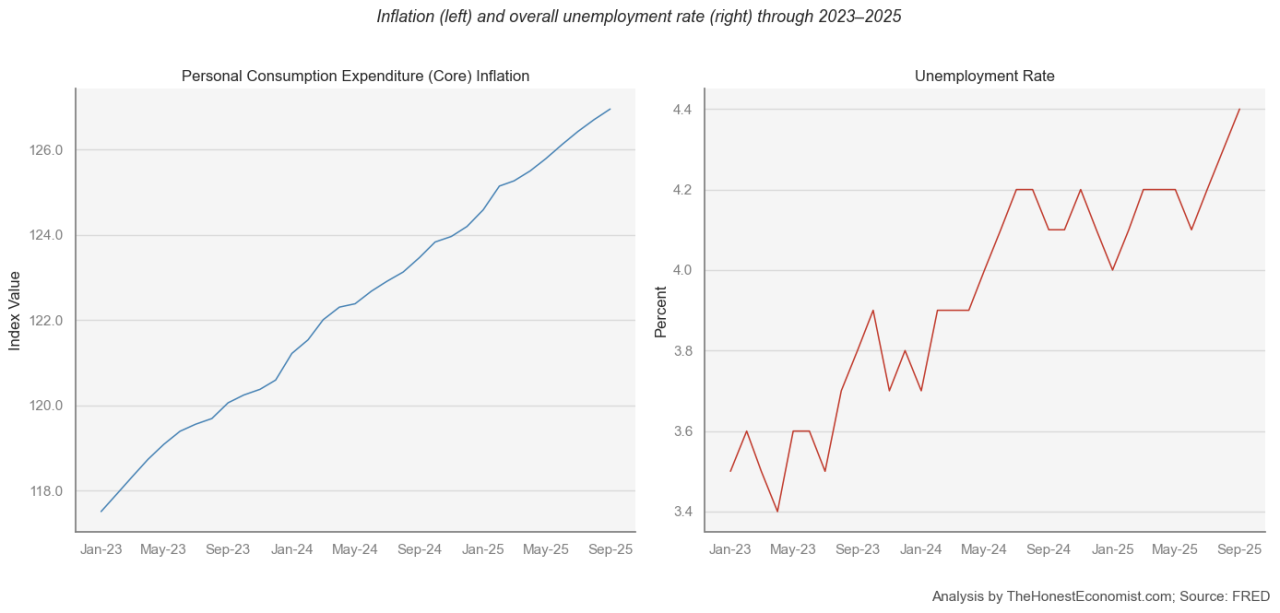
The charts display the simultaneous increase in core PCE inflation and overall unemployment.
Some commentators voice that the decision to cut rates was premature, as lower rates often increase the risk of higher inflation. Inflation has remained a major topic in modern political discourse for the past several years. According to the Wall Street Journal, cumulative inflation from 2021 to 2024 was 15.7%.
Lower interest rates make borrowing more attractive and saving cheaper. As a result, consumer spending and business investment typically increase, leading to inflation. Why add fuel to the fire?
The policy decision reflects a viewpoint that the economy should prioritize increasing employment over taming inflation. Recent statistics indicate that unemployment has reached 4.4%. This number, while not astonishingly high, represents a sizable uptick.
However, advocates against a lower interest rate retort that experts project the job market to bounce back in 2026, so lowering rates in response is not the answer.
In this article, I don’t take a stance on whether lowering the interest rate was a good or a bad decision in the context of both high inflation and high unemployment. Instead, I highlight this decision in the context of unemployment, particularly recent graduate unemployment.
To my knowledge, no other media outlet has commented on how the Fed's decision on interest rates could shape employment trends for this group.
According to a Fortune article from November, unemployment for recent college graduates has surged to 9.3% and is projected to reach 25%. This number represents a frightening increase since Kent and I wrote an article in September listing a figure of 5.8%. For all the commentary that the labor market will bounce back in 2026, these trends seem to suggest otherwise.
If the Fed’s intention to increase employment comes to fruition, we should measure the success of this decision based on whether it increases employment for all groups of workers, rather than solely focusing on aggregate employment.
Who Determines How Policy Lands?
Discussions regarding the potential impacts of major policy decisions, such as interest rate cuts, often appear speculative. We frame the issue in a forecasting-like manner as if we are trying to predict the weather. We often seem to forget our roles as participants who shape how these policy responses play out in real time.
One benefit to companies of the Fed lowering interest rates is a potentially expanded budget. In this type of economic environment, companies often pursue growth-oriented goals. Several activities fit under such goals, including hiring and investing in AI.
How companies respond when making hiring decisions will signal where their priorities lie and whether recent college grads will be deemed “worthy” enough for the AI-driven labor market.
A profit-seeking company will invest in AI over people if it undervalues the return of investing in the workforce. Uncertainty can also play a role. In a less uncertain environment, companies display more willingness to take on new hires.
If they desire to hire more recent college graduates but view them as slightly risky hires due to automation risks, then a lower interest rate could propel them to open more entry-level positions.
However, if they view recent graduates as unprofitable hires, then no amount of budget expansion will solve the unemployment problem that this group faces. Instead, they’ll likely invest in senior AI engineers or experienced workers.
In the age of AI, companies often desire more seasoned or experienced senior workers. Managers often quip that one senior worker with AI is more productive than one senior worker and four junior workers.
Hiring Could Exhibit Greater Disparities Among Generations
If the Fed's effort to increase employment lands as intended, then companies will hire more workers, decreasing the aggregate unemployment rate. However, most news coverage has not explicitly cited the unemployment problem among young workers as significantly contributing to its policy decision.
As I've previously written, the employment crisis among this group could lead to profound social consequences. A generation with lingering debt and lost opportunities is a generation of wasted economic potential.
To ensure the Fed's policy decision benefits all, companies must deliberately take action to ensure that recent graduates do not stay caught in the same bind. We should not read the lowering of the interest rate as a signal that the employment crisis will abate until we see meaningful action on the part of employers.
How Companies Can Make a Difference
I have come across numerous posts, articles, and talks asserting that recent graduates can gain an advantage by displaying an understanding of the industry and their potential value to a company.
These statements reveal a logical misalignment. When companies post open roles, the application process usually involves submitting a resume screened by AI as the first step. If applicants pass this round, they move on to a generic coding test or hiring assessment. At no point in this process can they barge into a boardroom and convince senior management that they’ll contribute value.
As we launch into 2026, companies will plan their budgets for the following year. Hiring discussions usually take place during these meetings. A hiring manager may voice, “The Fed just lowered interest rates. Now seems like a great time for hiring.”
Whether or not recent grads receive the benefit of such decisions if they occur hinges on companies' attitudes. If companies meaningfully think about how to leverage the talent and potential of young workers, they’ll have a worthy investment for years to come.
I have a few pieces of advice for anyone who works at a company, particularly hiring managers.
First, ensure that the language you use to describe recent college graduates or young workers more generally reflects their skills and competence. Try to avoid negative stereotypes such as "inexperienced" or "less productive than AI." Who really is more productive than AI anyway?
Second, understand that Gen Z may bring additional skills such as AI fluency and perspectives that you haven't otherwise considered.
Finally, understand that investing in the next generation can benefit your company for years to come. Now is the time to leverage potential reduced budgetary pressures for investing in young talent.
We're Not Passive Recipients of Policy
We often experience decisions made by the Federal Reserve as shocks with impacts completely out of our control. Although most of us are not FOMC members with direct control over interest rates, our power lies in how we respond to rate cut decisions.
Whether we agree or disagree with the Federal Reserve's decision to cut rates, we can control our responses. Everyday language we use to describe young workers or college graduates shapes whether those close to us, many of whom work at companies, decide to hire them.
Those who struggle most in the labor market could be your kids, your colleagues' family members, or your grandkids. It is both ethical and profitable for companies to seize this moment to invest in young talent.
We cannot look back in a few months or a year from now and claim that the lowering of rates created labor market opportunity unless young workers see an improved standing. We could squander the talent of a generation, or we could invest in them, ensuring a prosperous future for society for years to come.
Sources:
Bank at First. “Interest Rate Cuts and You.” Bank at First, n.d. https://www.bankatfirst.com/personal/discover/flourish/interest-rate-cuts-and-you.html
Cox, Jeff. CNBC. “Fed Interest Rate Decision: December 2025.” CNBC, December 10, 2025. https://www.cnbc.com/2025/12/10/fed-interest-rate-decision-december-2025-.html
Dickler, Jessica. CNBC. “College Graduates Are Struggling to Find Jobs—AI Is Partly to Blame.” CNBC, November 23, 2025. https://www.cnbc.com/2025/11/23/college-graduates-are-struggling-to-find-jobs-ai-is-partly-to-blame.html
Fore, Preston. Fortune. “Gen Z College-Grad Unemployment Could Hit 25 Percent, Warns U.S. Senator Amid Unprecedented AI Disruption.” Fortune, November 20, 2025. https://fortune.com/2025/11/20/gen-z-college-grad-unemployment-could-hit-25-percent-warns-us-senator-unprecedented-disruption-ai/
Jones, Cathy. “FOMC Meeting.” Charles Schwab, December 8, 2025. https://www.schwab.com/learn/story/fomc-meeting
Liu, Jennifer and Zachary Green. CNBC. “How Recent Grads Are Dealing With the Shrinking Pool of Entry-Level Jobs.” CNBC, December 8, 2025. https://www.cnbc.com/2025/12/08/how-recent-grads-are-dealing-with-the-shrinking-pool-of-entry-level-jobs.html
Smith, Colby. “Fed Meeting Interest Rate Decision.” The New York Times, December 10, 2025. https://www.nytimes.com/2025/12/10/business/economy/fed-meeting-interest-rate-decision.html
The Wall Street Journal Editorial Board. “WSJ Opinion: The Fed Cuts Interest Rates Again.” The Wall Street Journal, 2025.https://www.wsj.com/video/series/journal-editorial-report/wsj-opinion-the-fed-cuts-interest-rates-again/CE3126F0-507E-46BC-943E-90D5C40FF3FE