

Apply More, Hear Less, Feel Worse
by Mardoqueo Arteaga
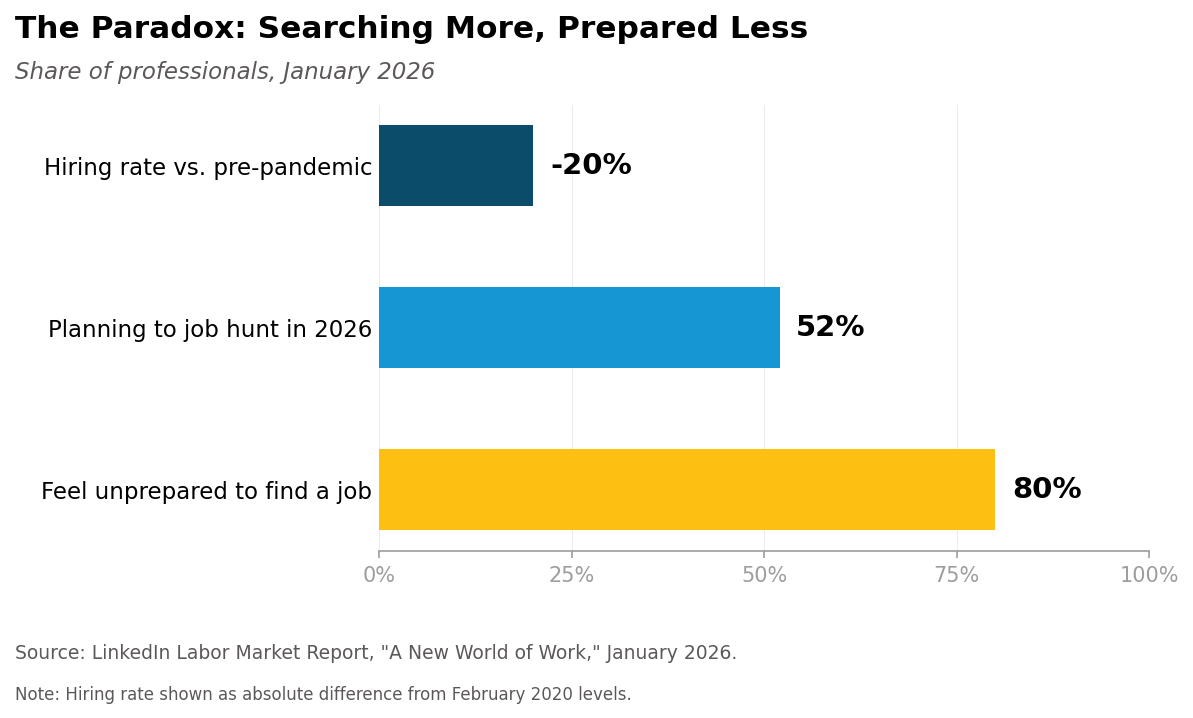
52% of professionals plan to job hunt in 2026. Nearly 80% feel unprepared to find one. Applications per job opening have doubled since 2022. Hiring is down 20% from pre-pandemic levels.
Read that again. More people are applying than ever. Fewer are getting hired. And the more they apply, the less confident they feel.
This is the same broken transmission mechanism showing up in consumer sentiment–and it's not a coincidence.

The Michigan survey came out last week. Consumer sentiment sits at 56.4, still more than 20% below where it was a year ago. Year-ahead inflation expectations ticked down to 4.0%, but long-run expectations crept up to 3.3%. Households continue to report pressure on their purchasing power from high prices and, crucially, the prospect of weakening labor markets.
That last part is the bridge. Consumer sentiment isn't just about inflation anymore. It's about jobs, which, by the numbers, looks fine: unemployment is 4.4%, historically low. But the experience of the job market feels terrible.
I studied how people form expectations. In my PhD research on household responses to Fed announcements, I found that people update their beliefs based on signals they can see and feel. A Fed rate cut doesn't change how you feel about the economy. A callback from a job application does.
When that callback never comes, confidence collapses even if the unemployment rate stays low.
The Paradox: Searching More, Prepared Less
LinkedIn's Labor Market Report, released at Davos this month, shows job seekers now outpace job openings at the highest level since the pandemic. In advanced economies, hiring is down 20-35% from pre-pandemic levels. The U.S. is stuck in what economists keep calling a "low-hire, low-fire" environment: companies aren't laying people off, but they're not bringing anyone new in either.
The result is a bottleneck where workers feel trapped and job seekers feel invisible.
The Conference Board's consumer confidence index fell for a fifth straight month in December, hitting 89.1, which is the lowest since tariffs were introduced in April. The labor market differential, which measures the gap between consumers who say jobs are "plentiful" versus "hard to get," is now at its lowest level since February 2021.
That differential matters because it captures the felt experience of the job market, not the statistical one. Unemployment can be 4.4% and still feel terrible if everyone you know has been searching for six months without a single interview.
The Feedback Loop
In a healthy job market, the cycle works: you apply, you hear back, you adjust your strategy. Information flows. Confidence builds or recalibrates based on real signals.
In the current market, the cycle is broken. You apply to 50 jobs. You hear nothing. You assume you need to apply to 100. Recruiters, flooded with applications, implement stricter AI filters. More applications get auto-rejected. You hear back even less. Confidence craters.
This is what I've called, in other contexts, a broken functor. A transmission mechanism where the intended signal doesn't propagate. The job market is sending one message (unemployment is low, the economy is stable) while job seekers are receiving another (nobody wants to hire me).
The psychological damage compounds. LinkedIn's research found that professionals who used AI tools in their job search were significantly more confident they'd find a job within a month (34%) compared to those who didn't (20%). That's not because AI guarantees you are more employable but because it gives you the illusion of agency (of doing something) when the feedback loop has otherwise gone silent.
The Michigan data reflects this same dynamic.
The survey asks people about business conditions, buying conditions, and personal finances. What sticks out to me in the January data is that sentiment improved slightly among lower-income consumers but fell among higher-income households. That's unusual because those households typically have more job security and better labor market outcomes.
But higher-income households are also the ones most likely to be job hunting for professional roles which is where the bottleneck is worst. They're the ones sending applications into the void. Their confidence is eroding precisely because the feedback loop that used to work for them no longer does.
The write-in responses in the Conference Board survey tell the same story. Consumers keep mentioning prices and inflation. But December saw increases in mentions of personal finances, interest rates, and income. The pain has shifted from "things cost too much" to "I'm not sure my job is secure and I don't know if I could find another one."
Metrics vs Experience
By the numbers, the labor market is okay. But the experience of the labor market is stuck in 2022. Applications go unanswered. Job searches drag on for months (and if you’re on the LinkedIn platform enough, you’ve seen these posts!). Companies post roles and then freeze the req. LinkedIn's data shows that founder activity is up 60% year-over-year globally, and you could take as a sign that more folks are giving up on traditional employment with how easy AI is putting creation tools at their fingertips. Similarly, nearly 4 in 10 Gen Z professionals now express interest in working for themselves. You could read this about optimism about entrepreneurship, or pessimism about ever getting hired.
The policy implications are uncomfortable.
The Fed watches inflation expectations. That's appropriate. But inflation expectations aren't formed in a vacuum. They're entangled with labor market expectations, which are entangled with the felt experience of job searching.
When the Michigan survey shows long-run inflation expectations creeping up to 3.3%, part of that is grocery prices. But part of it is the vague sense that the economy isn't working, or put simply, that the rules have changed and nobody told you. That sentiment will respond much more to getting a callback than it will to rate cuts or forward guidance.
Consumer spending remains resilient despite depressed sentiment. The explanation is straightforward: people are still employed, so they're still spending. But they're spending cautiously, because they don't trust that their job is secure and they don't believe they could find a new one if they needed to.
The 52% of professionals planning to job hunt are most likely anxious about their current situation, scanning the market not to advance but to hedge.
Takeaways
For job seekers, the practical advice is counterintuitive: apply less, but better. The mass-application strategy that worked in 2019 is actively counterproductive when AI filters are rejecting 90% of applications before a human sees them.
For employers, the message is simpler: respond. Even a rejection email is a signal. The silence is what's destroying confidence. Companies that move quickly and communicate clearly will have an enormous advantage in a market where 80% of job seekers feel demoralized.
For policymakers, the implication is that the labor market's health can't be measured by unemployment alone. The hiring rate, the callback rate, the time-to-hire—these are the metrics that shape how people actually feel about the economy. And how people feel about the economy shapes how they spend, save, and vote.
Works Cited:
Arteaga, Mardoqueo. “Monetary Policy Announcements and Household Expectations of the Future.” Journal of Economic Analysis, 2026, 5(1):130. doi:10.58567/jea05010002
Hsu, Joanne. “Surveys of Consumers: Final Results for January 2026.” University of Michigan, 23 Jan. 2026, www.sca.isr.umich.edu/.
LinkedIn Corporate Communications. "A New World of Work: Global Labor Market Rotates, Not Retreats." LinkedIn Pressroom, 14 Jan. 2026, news.linkedin.com/2026/2026-Davos-Press-Release.
LinkedIn Economic Graph. "Jobs on the Rise 2026: The 25 Fastest-Growing Roles in the U.S." LinkedIn, 7 Jan. 2026, www.linkedin.com/pulse/linkedin-jobs-rise-2026-25-fastest-growing-roles-us-linkedin-news-dlb1c
Conference Board. "Consumer Confidence Index: December 2025." The Conference Board, 7 Jan. 2026, www.conference-board.org/topics/consumer-confidence/.
U.S. Bureau of Labor Statistics. "Consumer Price Index Summary." Bureau of Labor Statistics, 21 Jan. 2026, www.bls.gov/news.release/cpi.nr0.htm.
U.S. Bureau of Labor Statistics. "Employment Situation Summary." Bureau of Labor Statistics, 9 Jan. 2026, www.bls.gov/news.release/empsit.nr0.htm.
World Economic Forum. "AI Has Already Added 1.3 Million Jobs, LinkedIn Data Says." World Economic Forum, 14 Jan. 2026, www.weforum.org/stories/2026/01/ai-has-already-added-1-3-million-new-jobs-according-to-linkedin-data/.
ZipRecruiter Economic Research. "2026 Labor Market Predictions." ZipRecruiter, Dec. 2025, www.ziprecruiter-research.org/commentary/2026-labor-market-predictions.